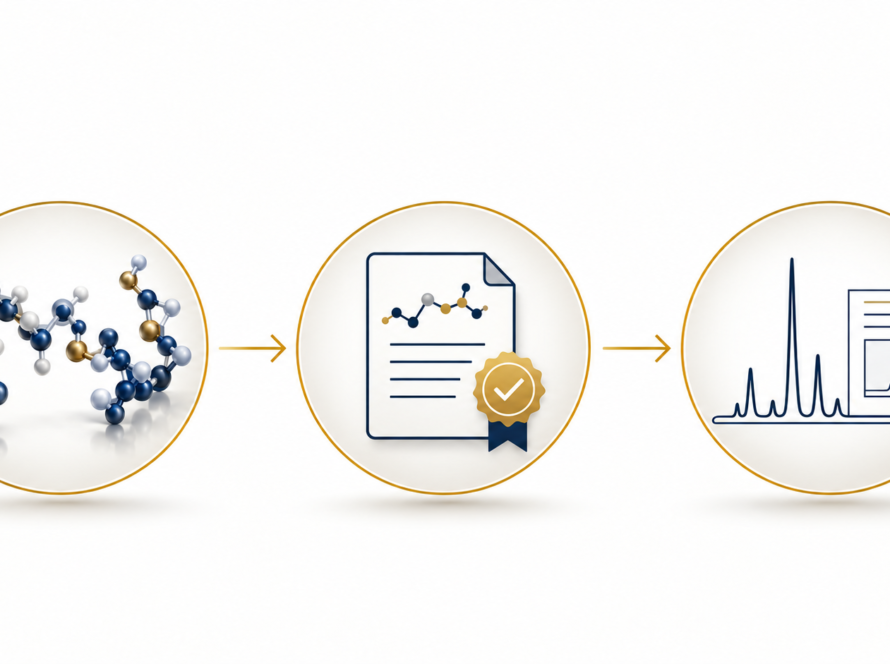


Lyophilized peptides are supplied as dry, freeze-dried materials because removing water can slow many degradation processes. Their stability still depends on the peptide sequence, salt form, container, storage temperature, moisture, light, oxygen, and handling history.
This guide explains how researchers evaluate lyophilized peptide storage without treating one general condition as a universal shelf-life guarantee.
For laboratory research and educational purposes only. Not for human or veterinary use.

What Lyophilization Changes in Peptide Stability
Lyophilization, also called freeze-drying, removes water from a frozen preparation under reduced pressure. The result is a dry cake or powder that is generally less chemically reactive than the same peptide in solution.
Drying does not make every peptide permanently stable. Sequence-specific features, residual moisture, oxidation-sensitive residues, container compatibility, and temperature changes can still affect the material.
The main point is a change of state: the dry form can be more stable, but its stability remains conditional on the material and the environment.
Why Lot Documentation Comes Before General Storage Advice
The supplier’s lot documentation should be the first reference for a specific research material. It may identify the peptide, salt or counter-ion, packaging, recommended storage condition, test date, and available analytical results.
General laboratory references are useful for planning, but they do not replace compound-specific documentation. A storage recommendation for one sequence or formulation should not automatically be transferred to another lot.
Researchers should keep the label and matching certificate of analysis with the lot record. A lot number, receipt date, storage location, and any temperature excursion are useful traceability fields.
How Moisture and Condensation Affect a Sealed Vial
Moisture is one of the most important risks for dry peptide material. A cold vial opened in humid air can develop condensation, which introduces water onto the lyophilized cake.
Researchers commonly allow a sealed vial to reach room temperature before opening it. This reduces the chance of condensation forming on the material. The vial should remain tightly closed whenever it is not being examined or sampled.
Moisture can increase molecular mobility in the solid and accelerate reactions that are slower in a dry state. Visible changes in the cake are worth recording, but appearance alone cannot confirm identity, purity, or stability.
Choosing Storage Temperature by Material State and Study Window
Storage temperature should follow the supplier’s lot documentation whenever available. General research guidance often uses colder storage for longer periods and refrigerator temperatures for shorter holding periods.
| Material state | General research consideration |
|---|---|
| Sealed lyophilized peptide | Keep dry, protected from light, and at the temperature specified by the supplier |
| Short-term holding | Refrigerated storage may be appropriate when supported by documentation |
| Longer-term storage | Freezer storage is commonly used, often around −20°C or colder |
| Sensitive reference material | Deeper freezing may be selected when supported by a stability program |
These temperatures are general laboratory references, not a universal expiry guarantee. The exact sequence, salt form, formulation, packaging, and lot data remain decisive.
Short-term versus longer-term storage
Short transit or brief handling at room temperature does not establish long-term room-temperature stability. Conversely, a colder storage condition does not by itself prove that a material will remain unchanged indefinitely.
The study window should be defined before storage begins. A stability plan can compare selected timepoints and conditions against the original lot results.
Light, Oxygen, and Container Contact: Why They Matter
Some amino acids are more susceptible to oxidation or light-related degradation. Cysteine, methionine, and tryptophan are commonly identified as residues that require additional attention.
For sensitive materials, researchers may document:
- Light exposure during storage
- Container closure integrity
- Headspace and oxygen exposure
- Whether amber or opaque containers are used
- Whether the supplier recommends an inert-gas environment
Peptides can also interact with glass, plastic, rubber, or other surfaces. Container compatibility should be considered when a low-concentration sample, a long storage period, or an adsorption-sensitive sequence is involved.
The correct control depends on the peptide and the analytical method. A general container rule cannot replace a method-specific assessment.
Why Solution Stability Must Be Evaluated Separately
A lyophilized vial and a reconstituted solution should not be treated as having the same stability profile. Once a peptide is placed in solution, additional variables become important:
- Solvent composition
- pH and ionic strength
- Concentration
- Container material
- Exposure to air and light
- Time at each temperature
- Number of freeze–thaw cycles
The stability of a solution must therefore be supported by compound-specific or formulation-specific data. A dry-powder storage recommendation does not automatically establish the stability of a prepared solution.
This distinction is especially important when comparing a supplier’s COA for a dry lot with a later test result from a solution. The two samples may have different handling histories and may not answer the same analytical question.
Freeze–Thaw Stress and Traceable Aliquot Records
Repeated temperature cycling can affect both dry materials and peptide solutions. In solutions, freeze–thaw cycles can promote aggregation, adsorption, oxidation, and changes in concentration.
When repeated sampling is required, laboratories commonly prepare documented aliquots rather than repeatedly exposing one stock container to temperature changes. The number of cycles should be recorded as part of the experiment.
An aliquot record can include:
- Parent lot number
- Aliquot identifier
- Preparation date
- Storage condition
- Number of thaw events
- Analyst or laboratory identifier
- Retest result, if performed
This record helps researchers distinguish a material change from a documentation or handling error.
What HPLC, LC-MS, and Related Methods Can Confirm
Stability assessment should match the question being asked. No single method measures every quality attribute.
HPLC and chromatographic purity
RP-HPLC can separate the target peptide from some related impurities and degradation products under a defined method. A changed chromatogram may support an investigation, but the result depends on the column, mobile phase, detector, gradient, reference material, and reporting convention.
LC-MS and mass information
LC-MS can provide molecular-mass information and may help investigate changes such as oxidation or other modifications. A matching mass does not prove that every impurity, isomer, aggregate, or sequence-related product has been excluded.
Aggregation and physical change
Depending on the material and question, laboratories may use size-based or complementary methods to investigate higher-molecular-weight species, particles, adsorption, or changes in solution behavior.
The appropriate test plan should be written before the stability study starts. Published analytical reviews describe HPLC, LC-MS, SEC, electrophoresis, spectroscopic methods, and activity assays as complementary tools rather than interchangeable tests.
What Visual Changes Can and Cannot Tell Researchers
Visual inspection can record changes such as:
- Collapse or shrinkage of the cake
- Discoloration
- Unusual particles
- Cloudiness after dissolution
- Changes in clarity or precipitate formation
These observations may justify further review, but they cannot confirm molecular identity or purity. A material can look normal while still requiring analytical testing, and a visible change may reflect packaging or handling rather than a single known degradation pathway.
Evidence Limits and Research-Use-Only Scope
General storage guidance cannot establish:
- A universal shelf life for every peptide
- Stability of every salt form
- Stability of a specific product without lot testing
- Stability of a solution from dry-powder data alone
- Biological activity from a purity percentage alone
- Equivalence between two suppliers or batches
Research conclusions should remain tied to the exact material, method, storage condition, and study design. A certificate of analysis reports selected results for a particular lot and test date; it is not a universal shelf-life guarantee.
Peptide storage information is intended for controlled laboratory research and analytical documentation. It is not a recommendation for human or veterinary use, treatment, dosing, injection, or self-administration.
For laboratory research and educational purposes only. Not for human or veterinary use.
Frequently Asked Questions
Should lyophilized peptides be refrigerated or frozen?
The correct condition depends on the supplier documentation and the peptide’s stability profile. General laboratory guidance often uses colder storage for longer periods, with protection from moisture and light.
Why should a cold vial warm before opening?
Allowing the sealed vial to reach room temperature reduces condensation and limits moisture exposure to the lyophilized material.
Is the same storage temperature suitable for every peptide?
No. Sequence, salt form, packaging, residual moisture, and oxidation sensitivity can change the appropriate storage strategy.
Does a COA prove the peptide will remain stable?
No. A COA reports characteristics for a specific lot and test date. Long-term stability requires documented storage conditions and, when necessary, retesting.
Why are repeated freeze–thaw cycles avoided?
Temperature cycling can increase aggregation, adsorption, oxidation, or concentration changes, particularly after the peptide has been placed in solution.
Can visual appearance confirm peptide quality?
No. Appearance can provide a useful observation, but identity, purity, content, and degradation require appropriate analytical methods.
Research resources and related reading
For documentation and analytical context, see our COA, HPLC, and mass spectrometry checklist, peptide reconstitution guide, and peptide research resources. Browse the Research Methods & Quality and Laboratory Safety & Solutions categories for related articles.
Sources
- Sigma-Aldrich: Handling and Storage Guidelines for Peptides and Proteins
- Recommendations for the Generation, Quantification, Storage and Handling of Peptides Used for Mass Spectrometry-Based Assays
- Regulatory Guidelines for the Analysis of Therapeutic Peptides and Proteins
- Reference Standards to Support Quality of Synthetic Peptide Therapeutics
- Thermo Fisher: Custom Peptide Storage and Dissolution