


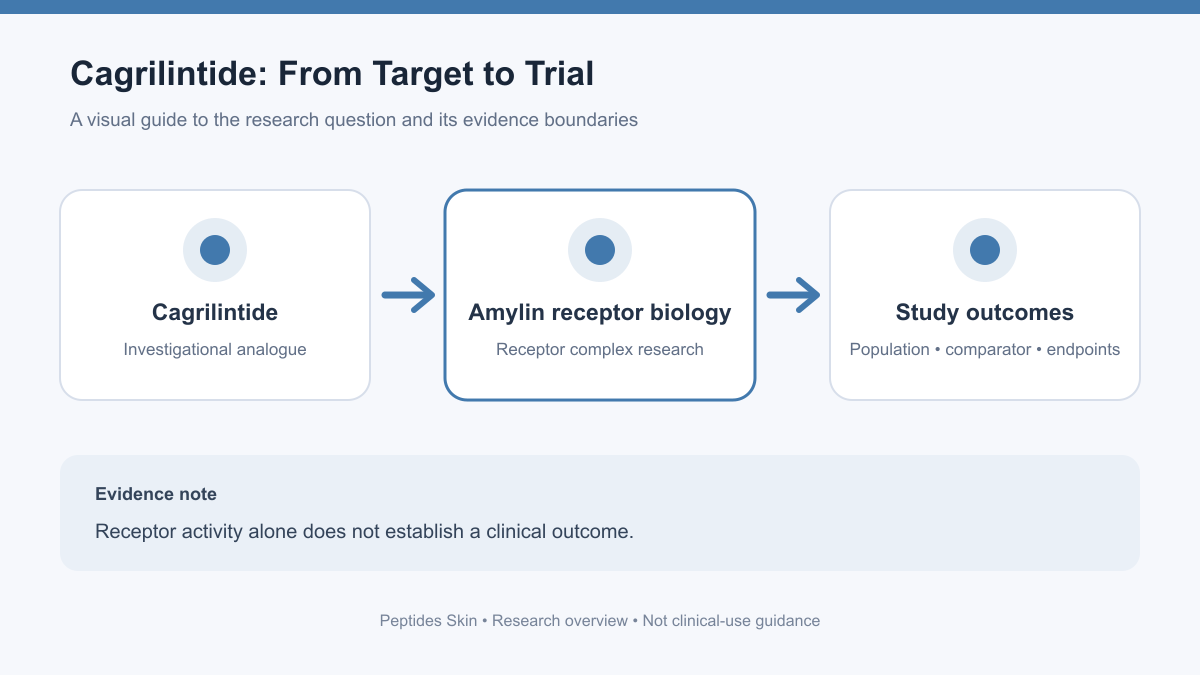
Cagrilintide research examines a long-acting amylin analogue and its effects in controlled clinical studies. Amylin is a hormone involved in appetite and post-meal physiology. A mechanism can motivate a trial, but it cannot by itself establish benefits or risks. This guide summarizes the research questions, study design, and limits of the published evidence.
What Is Cagrilintide?
Cagrilintide is an investigational amylin analogue studied on its own and in combination with semaglutide. Researchers evaluate defined formulations under protocol conditions. Results from one formulation should not be generalized to products with similar names or to untested combinations.
Amylin pathway context
Amylin signaling is studied in relation to satiety and gastric emptying. These are biological research areas, not proof that a specific unapproved product safely produces a particular outcome.
How Clinical Studies Measure Outcomes
Randomized studies specify who can participate, which comparison groups are used, how long follow-up lasts, and which outcomes are primary. Investigators may report body-weight change, metabolic measures, tolerability, and adverse events. Read the methods and tables alongside the headline result.
Why comparators matter
A placebo or active comparator helps distinguish measured changes between groups. Differences in population, trial duration, and analysis can make studies difficult to compare directly.
What Published Evidence Can Show
Phase 2 research has evaluated cagrilintide at defined doses, while later research has examined the cagrilintide and semaglutide combination. These studies answer specific questions about the tested protocol. They do not establish outcomes for every population, duration, or product source.
Reading Results Carefully
Look for the prespecified primary endpoint, confidence intervals, participant numbers, withdrawals, and adverse-event reporting. Separate observed results from proposed mechanisms. A group average is not an individual prediction, and a short trial cannot settle every long-term question.
Formulation-specific evidence
Clinical evidence belongs to the exact formulation and study conditions evaluated. Similar names alone do not show equivalent identity, quality, or clinical evidence.
Limits and Open Questions
Ongoing research may add evidence, but conclusions should track the current published record. This educational overview is not personal medical advice and does not provide instructions for using investigational compounds.
Frequently Asked Questions
Is cagrilintide the same as semaglutide?
No. They are different compounds studied through different biological targets.
Has cagrilintide been studied in combination?
Yes. Published trials have examined a defined combination with semaglutide; the results apply to that formulation and protocol.
Can one trial establish long-term safety?
No. Safety conclusions depend on trial size, duration, population, and follow-up.
Catalog context: For a current catalog reference related to amylin-pathway research, review the Cagrilintide catalog record on Peptides Skin for listed formats and research-use-only documentation. Availability and documentation may change, so match the exact product record to the applicable laboratory workflow.
References
- Randomized phase 2 study of cagrilintide.
- Phase 2 trial of cagrilintide plus semaglutide.
- Phase 3 CagriSema study in type 2 diabetes.
See the Peptides Skin research resources for related evidence-reading guides.

Cagrilintide by Peptides Skin
PeptidesSkin.us and PeptidesSkin.com are the same Peptides Skin brand. This page provides research context; the catalog link provides product information and does not establish equivalence to material used in studies.