

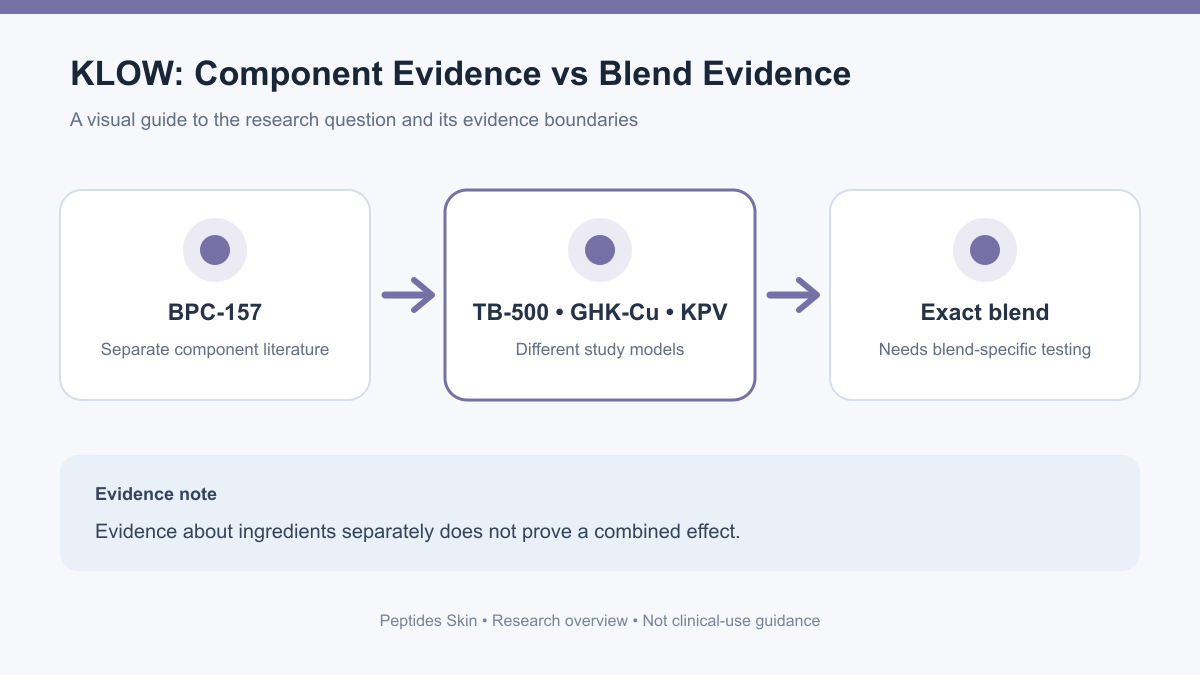
KLOW blend research requires a careful distinction between studies on individual ingredients and evidence on the exact combined formulation. A paper about one component cannot establish that a four-component blend is effective, safe, or synergistic. This guide maps the evidence question by question.
Identify the Exact Blend
Before evaluating a blend claim, verify which compounds, amounts, formulation, and analytical methods are specified. A blend name alone may not define a consistent composition. Without that information, readers cannot confidently connect a study to the product being discussed.
Component Studies Are Not Blend Trials
Published research on BPC-157, TB-500 or thymosin-related materials, GHK-Cu, and KPV examines different models and outcomes. Some evidence is preclinical. These papers can inform separate hypotheses, but they do not test the exact KLOW combination as a unit.
What Would Demonstrate Synergy?
A synergy claim requires direct comparison of the combination with its individual components and suitable controls, using a prespecified design. Merely combining plausible mechanisms does not demonstrate that the effects add together or improve outcomes. A blend-specific study is needed.
How to Evaluate Evidence Quality
Check whether the study is peer reviewed, whether the full methods are available, what model was used, and whether independent groups replicated the finding. Track each ingredient to its own source and avoid applying cell or animal findings to people without supporting clinical evidence.
Evidence Boundaries
Marketing descriptions and component bibliographies are not substitutes for controlled studies of the exact formulation. Until such studies exist, conclusions about blend-specific effects should remain limited. This article is educational and does not offer protocols for using research compounds.
Frequently Asked Questions
Do studies on the ingredients prove the blend works?
No. They support ingredient-specific questions, not conclusions about the exact blend.
Does a combination automatically create synergy?
No. Synergy must be tested against appropriate component and control groups.
Are preclinical results human evidence?
No. Cell and animal findings do not establish outcomes in people.
References
- BPC-157 and VEGFR2 research.
- BPC-157 tendon-cell study.
- GHK-Cu collagen research.
- KPV intestinal inflammation model.
- Scoping review of peptide evidence.
Explore our Peptides Skin research resources for evidence-reading guidance.