

A result can be internally credible yet still fail to generalize beyond the experiment that produced it. In peptide research, these are common peptide study limitations: differences in model, endpoint, batch, formulation, and analytical method can change what a result means. This article provides a disciplined way to describe those limits without dismissing useful findings or making clinical or personal-use claims.
Short summary: Separate internal validity from external validity, compare the tested model with the implied target context, track batch and method differences, and state exactly which inference is supported, proposed, or untested.
What does generalization mean in peptide research?
Generalization is the move from a specific experiment to a wider set of conditions, materials, models, or populations. A study may show a reproducible signal in its own system while leaving open whether the same signal appears with another species, cell line, endpoint, formulation, batch, or laboratory. A careful article names the boundary rather than treating “positive” as universal.
Internal validity and external validity are different
Internal validity asks whether the observed difference is reasonably attributable to the tested condition under the study design. Controls, randomization, blinding, assay quality, and complete reporting support that judgment. External validity asks where the result may hold beyond that setup. A well-controlled cell experiment can have strong internal validity and still have limited external validity if receptor expression or metabolism differs from the context a reader has in mind.
Model limits: cells, animals, and human contexts
Cell systems can isolate a pathway, but immortalized lines may not reproduce primary-cell receptor density, metabolism, or tissue architecture. Animal models add systemic biology, yet species differences in target distribution, clearance, immune response, and behavior can matter. Human studies add real-world heterogeneity and operational complexity, but their population, formulation, and endpoint still define the scope of inference.
When comparing tiers, list the model features that are shared and the features that are not. Avoid phrases such as “the animal result proves the human result.” A more accurate statement is that the animal result supports a hypothesis that requires evidence in the relevant human context.
Endpoint limits: the same peptide can answer different questions
Binding, pathway phosphorylation, gene expression, cell viability, body composition, and a clinical outcome are different endpoints. A change in an upstream marker may be mechanistically informative without predicting a downstream phenotype. Two studies that use the same peptide but different endpoints should not be pooled by headline alone.
Record whether the endpoint was primary or exploratory, direct or proxy, validated or newly developed, and whether the analysis was prespecified. Use the Learn hub to keep evidence tiers visible and the Research Library to link the original methods.
Batch and formulation limits
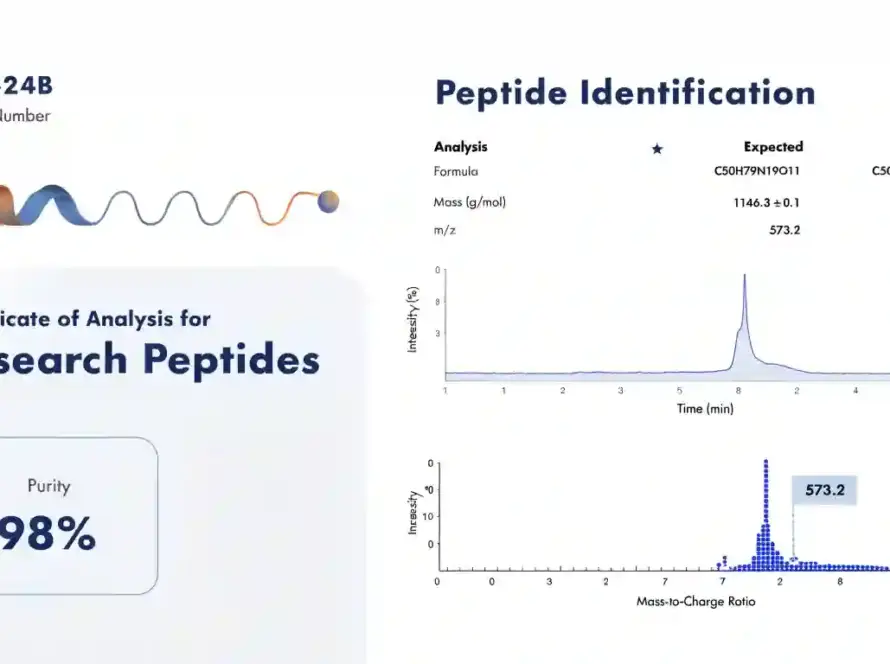
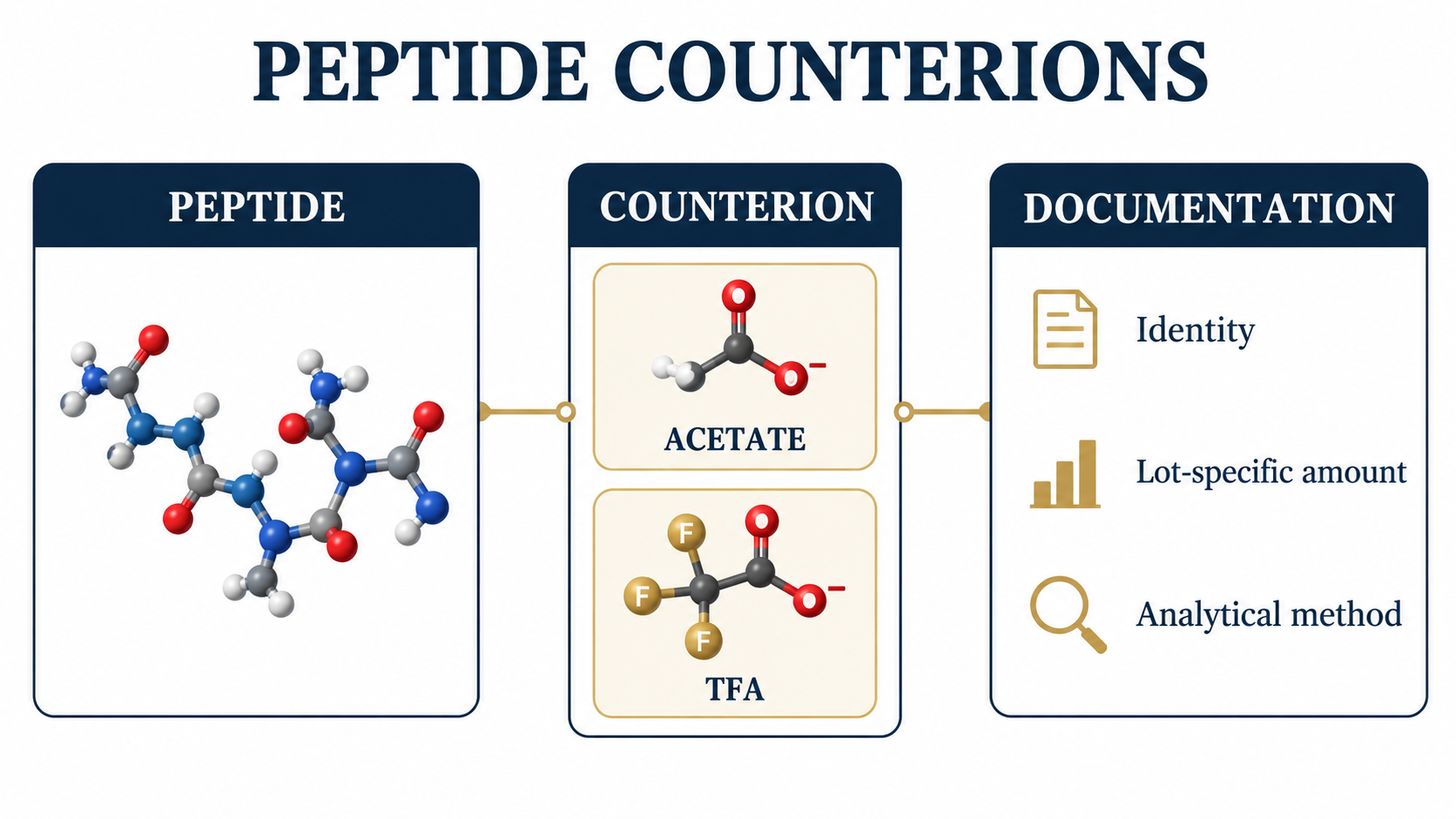
Peptide identity is only one part of comparability. Salt or counterion form, purity profile, residual solvent, excipients, concentration, container, and handling can alter the material tested. Two papers may use the same short name while studying different forms or batches. A COA can document selected characteristics of a specific batch, but it cannot transfer a biological result to every other batch.
For documentation, cross-check the exact reference, batch or lot, analytical method, and sample preparation. The quality checklist and counterion article explain why those fields belong in a study comparison.
Method limits and laboratory transfer
Assays can respond differently to the same sample. Mobile phase, detector, calibration, extraction, plate type, instrument settings, and analysis software may change recovery or sensitivity. A method transfer should document equivalence rather than assuming that a signal has the same meaning in another laboratory.
Orthogonal methods, blinded reanalysis, reference standards, inter-laboratory comparisons, and transparent raw-data decisions make transfer more credible. When methods disagree, report both observations and investigate whether the difference is biological, chemical, or analytical.
Replication, heterogeneity, and generalizability tests
Replication is not limited to repeating one run. Generalizability tests can vary operators, batches, sites, models, and prespecified conditions. A 2013 systematic review of preclinical efficacy studies describes construct, internal, and external validity as separate threats. A 2023 review discusses heterogenization, multicenter work, and explicit generalizability testing as ways to learn where a result travels.
How to write a bounded conclusion
- Established: the direct result in the reported model, endpoint, batch, and method.
- Proposed: the mechanism or transfer hypothesis consistent with the pattern.
- Unresolved: the other models, populations, batches, endpoints, or methods not tested.
This structure lets readers use a result without overstating it. It also makes future studies additive: each new model, batch, or method can expand—or narrow—the evidence boundary.
Research-use-only boundary
This article is an educational guide to study interpretation and generalizability. It does not provide dosing, administration, diagnosis, prevention, treatment, or personal-use instructions. For laboratory research and educational purposes only. Not for human or veterinary use.
Frequently asked questions
Does strong internal validity guarantee generalization?
No. It supports attribution within the tested setup. External validity requires evidence that the result travels to the new context.
Why record batch and formulation?
Different forms or batches can have different impurity and physical profiles, so a result tied to one material should not be generalized automatically.
Can a proxy endpoint prove a clinical outcome?
No. A proxy may be informative, but the relationship to a different outcome must be demonstrated rather than assumed.
What is a generalizability test?
It is a planned test of whether a finding remains interpretable across relevant changes in model, site, operator, batch, or method.
How should mixed results be reported?
Report the conditions that differed, preserve null findings, and state which inference is supported, proposed, or unresolved.