


A synthetic peptide may be supplied as a salt containing an ion that balances its charged groups. Acetate and trifluoroacetate (TFA) are two counterions encountered in peptide research materials. They describe part of the isolated material, but neither label alone tells a researcher the peptide’s identity, chromatographic purity, content by mass, or suitability for a particular analytical method.
This guide explains what the salt-form words mean, why a counterion can matter to a lot record, how laboratories measure it, and which conclusions should remain open until supported by data. It is an interpretation guide, not a procedure for preparing or using a material.
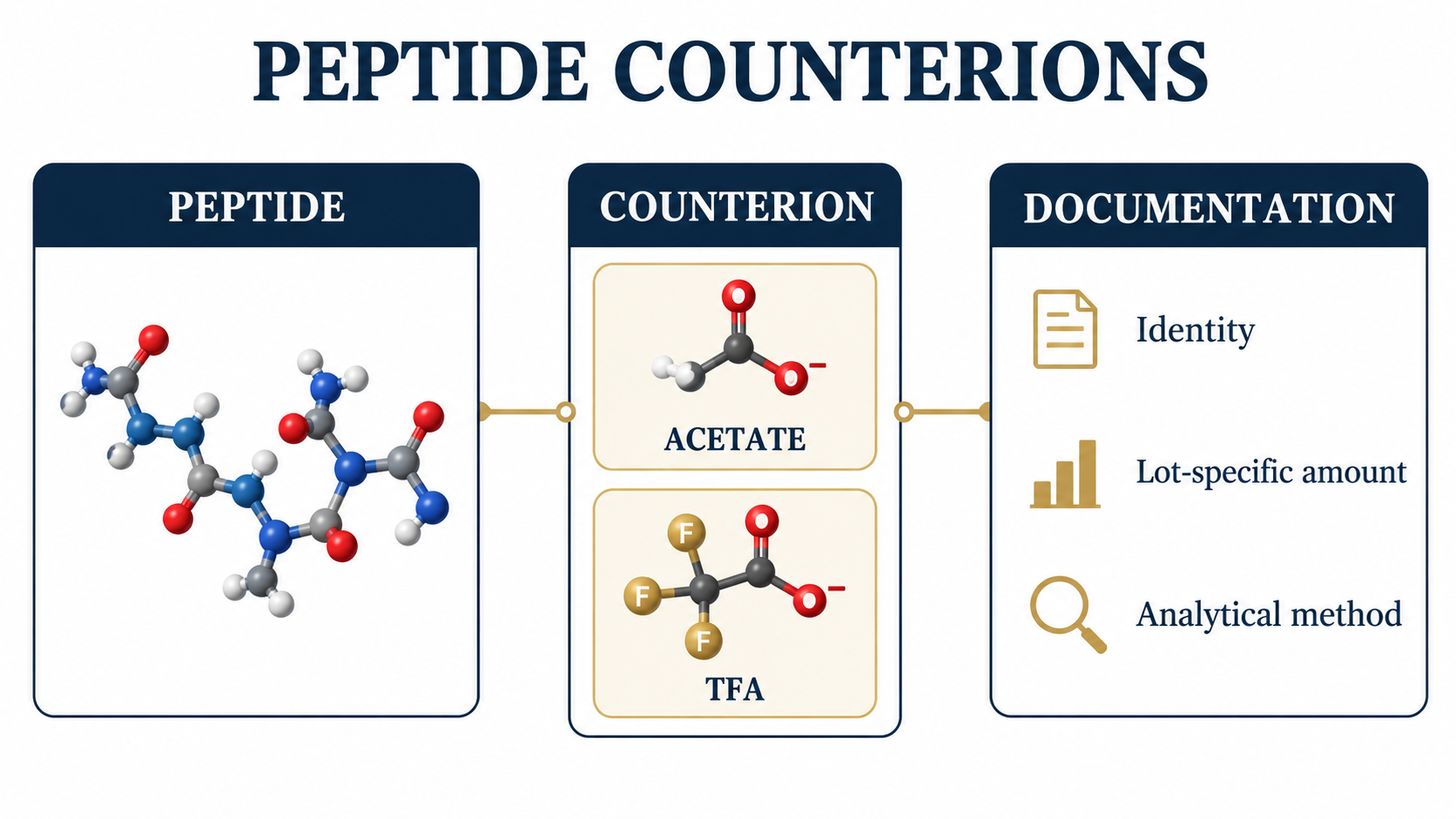
What is a peptide counterion?
A counterion has an opposite charge to a charged part of a molecule. In an isolated peptide salt, anions such as acetate or trifluoroacetate can accompany protonated groups on the peptide. The actual composition can depend on the sequence, process, and conditions. A salt-form name is therefore a description of the material and should be connected to a specified lot and analytical evidence.
Counterion and peptide sequence are different properties. “Peptide acetate” does not mean the peptide has been N-terminally acetylated. Acetylation is a covalent modification; an acetate counterion is not the same modification. Likewise, the designation “TFA salt” should not be read as a statement that every possible impurity has been measured.
Why do acetate and TFA appear in synthetic peptide records?
Acidic reagents are used in many peptide synthesis and purification workflows, and the final isolated material can contain anions associated with that process. Published analytical work has specifically examined acetate and trifluoroacetate in synthetic peptide samples. For example, Hettiarachchi and Ridge (1998) developed capillary electrophoretic determination of acetic acid and TFA in such materials. Their paper notes that these species may arise as counterions or process-related residues.
A 2025 study of selected synthetic peptides evaluated a purification and counterion-exchange approach and characterized the resulting materials with multiple methods. That study supports the narrower point that a process can change a measured counterion profile in the tested peptides. It does not establish that every commercial peptide sold as acetate has identical composition or that exchange is universally complete.
Salt form, HPLC purity, and peptide content answer different questions
Peptide identity and chromatographic purity
An identity method asks whether the material is consistent with the intended peptide. A chromatographic purity result describes the peaks detected and integrated under a stated procedure. Neither a sequence assignment nor a single purity percentage automatically quantifies acetate or TFA in the powder. The USP-associated 2023 review lists separate analytical approaches for peptide identity, peptide impurities, acetic acid, and TFA. That separation is useful when reading a supplier certificate.
Counterion amount and content by mass
Counterions contribute to the mass of an isolated salt. Water and other non-peptide components can contribute too. As a result, a high HPLC area percentage cannot be substituted for peptide content by mass. A quantitative claim requires the appropriate value, basis, and method for that specific lot. Our separate guide to peptide purity versus content explains the distinction in more detail.
How can acetate or TFA be measured?
The method must address the ion being reported and be suitable for the sample matrix and reporting range. Published studies have used ion chromatography, capillary electrophoresis, and other techniques to assess peptide counterions. Kaiser and Rohrer (2004) described ion chromatography for residual TFA in protein purification buffers and peptide preparations. Mrozik and colleagues (2012) compared ion chromatography with capillary techniques for acetate, trifluoroacetate, and chloride in synthetic peptides.
The United States Pharmacopeia lists separate peptide-related chapters for acetic acid and TFA, <503> and <503.1>. Their presence in a standards catalog shows that these are distinct analytical questions; it does not imply that every research supplier performs those tests on every lot. A chromatogram or certificate should name the method and the measured attribute rather than rely on “tested” as a complete explanation.
What to check in a lot-specific record
- Material identity: peptide name or sequence, modification status, and lot identifier.
- Salt-form wording: whether acetate, trifluoroacetate, another counterion, or an unspecified form is stated.
- Counterion measurement: the measured ion, method, result, units, reporting basis, and any stated limit.
- Separate quality results: peptide identity, peptide-related purity, and peptide content should not be treated as interchangeable.
- Documentation scope: note which attributes were actually tested, which were calculated or inferred, and which remain unreported.
A label is a starting point for interpretation. For questions about a particular batch, use the certificate and supporting report tied to that lot. Our COA reading guide and reference standards guide show how to separate an analytical result from a broader claim that the record does not support.
What published evidence does and does not establish
The analytical literature demonstrates that acetate and trifluoroacetate can be measured in synthetic peptide preparations and that counterion profiles can differ with process and material. It does not establish one universal salt composition, one universally preferable salt, or a fixed percentage for all peptide sequences and lots. Differences in sequence, charge, water content, and processing limit simple comparisons.
A 1987 report described one salt-form conversion in a specified peptide, while later work evaluated other selected peptides and methods. Such studies provide examples of analytical and process behavior. They do not replace lot-specific characterization for a material obtained from a different supplier or process. Inference about a current lot should be labeled as inference until a relevant test confirms it.
Frequently asked questions
Is acetate the same as N-terminal acetylation?
No. Acetate describes an ion associated with a charged peptide salt. N-terminal acetylation is a covalent modification of the peptide chain. The two labels describe different chemical features.
Does an acetate salt automatically have higher purity than a TFA salt?
No. Salt form and chromatographic purity answer different questions. Compare the lot-specific identity, purity method, counterion result, and peptide-content basis before interpreting two materials.
Can a peptide be reported as acetate while residual TFA is still present?
It can be possible after an exchange process. The final composition depends on the process and should be assessed by a method that measures the relevant ions. The label alone does not prove complete replacement.
Does an HPLC purity percentage measure acetate or TFA content?
A peptide-purity chromatogram usually measures a defined set of peptide-related peaks under its method. Counterion content needs a suitable separate analytical measurement or a validated method that includes it.
What should a researcher look for on a lot record?
Look for the named salt form, matching lot identifier, method and result for any reported counterion, peptide purity and content stated separately, and the basis used for quantitative values. Treat missing measurements as information gaps rather than inferred results.
Primary sources and further reading
- McCarthy D, et al. Reference Standards to Support Quality of Synthetic Peptide Therapeutics. Pharmaceutical Research. 2023. DOI: 10.1007/s11095-023-03493-1. Analytical attributes and methods for synthetic peptides.
- Hettiarachchi K, Ridge S. Capillary electrophoretic determination of acetic acid and trifluoroacetic acid in synthetic peptide samples. Journal of Chromatography A. 1998. DOI: 10.1016/S0021-9673(98)00328-8.
- Kaiser E, Rohrer J. Determination of residual trifluoroacetate in protein purification buffers and peptide preparations by ion chromatography. Journal of Chromatography A. 2004. DOI: 10.1016/j.chroma.2004.03.044.
- Gabriel TF. Simple, rapid method for converting a peptide from one salt form to another. International Journal of Peptide and Protein Research. 1987. DOI: 10.1111/j.1399-3011.1987.tb03310.x.
- Mrozik A, et al. Determination of counter-ions in synthetic peptides by ion chromatography, capillary isotachophoresis and capillary electrophoresis. Journal of Peptide Science. 2012.
- United States Pharmacopeia. Peptide-related USP–NF Documentary Standards and Reference Standards. 2023 listing of chapters <503> and <503.1>.
- A New Methodology for Synthetic Peptides Purification and Counterion Exchange in One Step Using Solid-Phase Extraction Chromatography. Processes. 2025. Full paper. Example on selected peptides, not a universal supplier specification.
Related laboratory research guides
Continue with HPLC vs LC-MS peptide analysis, peptide batch testing, and our Research Resources library.
Research-use-only boundary: For laboratory research and educational purposes only. Not for human or veterinary use.


2 Comments