

Quick answer: Pharmacokinetics (PK) describes how an investigational molecule’s concentration changes over time in a study. Retatrutide research reports concentration and exposure measures alongside protocol-specific safety and outcome data. PK values such as Cmax, AUC, and half-life answer different questions; none alone predicts an individual’s response or verifies a separate product.
Searches about retatrutide pharmacokinetics often reduce a complex study to one number. This overview explains what researchers measure and how to interpret the terms in a paper without turning group-level data into personal-use guidance.
What pharmacokinetics means in retatrutide research
Pharmacokinetics studies concentration over time. In a clinical trial, investigators use a defined investigational material, protocol, sampling schedule, and validated assay to estimate drug exposure. The resulting measurements describe participants in that study and depend on the design and analysis methods.
PK is distinct from pharmacodynamics (PD), which studies biological responses associated with exposure. A concentration-time result and a clinical endpoint may be analyzed together, but one does not substitute for the other.
Which exposure measures appear in PK studies?
Cmax and Tmax
Cmax is the highest measured concentration in a specified sampling interval. Tmax is the time at which that observed peak occurs. Both depend on the collection schedule and protocol; sparse sampling can affect how precisely a peak is observed.
AUC
The area under the concentration-time curve (AUC) summarizes measured exposure over a defined period. The time window and calculation method matter. AUC values should be compared only when the study populations, assays, schedules, and analysis definitions make the comparison meaningful.
Half-life
Half-life summarizes a concentration decline during a defined elimination phase. A Phase 1b study of LY3437943 reported an approximate six-day elimination half-life. That number describes a pharmacokinetic estimate from the study; it does not equal effect duration or vial stability.
How researchers collect and interpret concentration data
Investigators collect timed samples and quantify concentrations with an analytical method designed for the study. They then assess the concentration-time profile and calculate prespecified measures. The interpretation depends on participant characteristics, sample timing, assay performance, below-quantification values, and the statistical model.
Questions to check in the paper
- Which population was studied, and what were the eligibility criteria?
- When were samples collected and for how long?
- Which assay and PK analysis methods were used?
- Were estimates reported as means, medians, ranges, or model-derived values?
- What variability and uncertainty accompanied the estimate?
PK is not the same as clinical effect
Exposure can help characterize a molecule, but clinical effects are studied through defined endpoints and follow-up. The relationship between concentration and response may be complex and can differ by outcome and participant. A single PK measure does not establish efficacy, safety, or a clinically useful duration.
PK is not product identity or stability testing
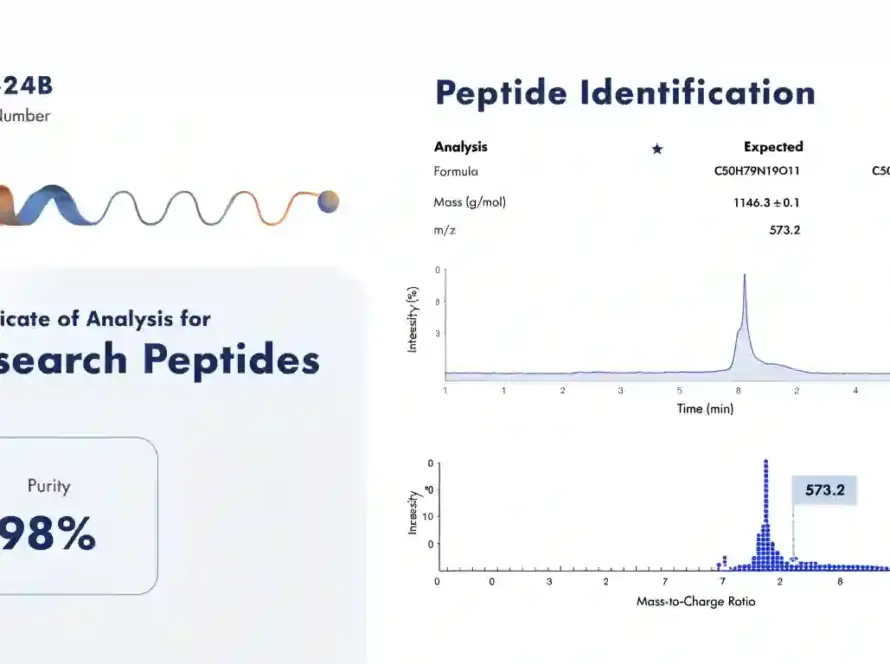
Clinical PK data concern the investigational material used in a controlled study. They do not verify an online product or a particular batch. Product identity requires suitable batch-specific analytical evidence; storage stability is a separate question studied under specified conditions. Neither can be inferred from a published half-life.
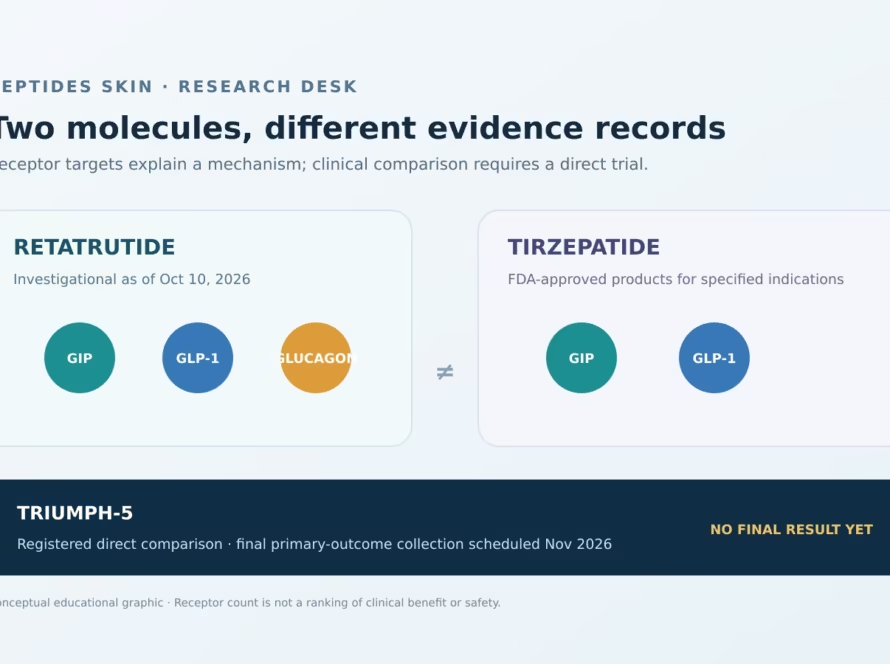
As of October 10, 2026, retatrutide remains investigational and is not FDA-approved. This article does not provide dosing, preparation, injection, treatment, or sourcing guidance.
Retatrutide pharmacokinetics FAQs
What is Cmax?
Cmax is the maximum measured concentration within a defined sampling period in a study.
What does AUC show?
AUC summarizes measured exposure over a defined time window; its value depends on how the study defines and calculates it.
Does half-life predict how long an effect lasts?
No. Half-life describes a concentration-time estimate, while duration of a biological or clinical effect requires separate evidence.
Can a PK paper verify a research product?
No. It reports measurements for study material under a study protocol and does not authenticate an unrelated sample.
References
- Urva S, et al. LY3437943 in people with type 2 diabetes: a Phase 1b trial. The Lancet Diabetes & Endocrinology. 2022;10(9):646–656. doi:10.1016/S2213-8587(22)00233-5.
- Jastreboff AM, et al. Triple-Hormone-Receptor Agonist Retatrutide for Obesity—A Phase 2 Trial. New England Journal of Medicine. 2023;389:514–526. doi:10.1056/NEJMoa2301972.
- ClinicalTrials.gov. Retatrutide study records. Accessed October 10, 2026.
- U.S. FDA. FDA’s concerns with unapproved GLP-1 drugs used for weight loss. Accessed October 10, 2026.
Editorial note: This research-literacy article is not medical advice or a product endorsement. Reviewed October 10, 2026.