


A peptide reference standard is a characterized material used to compare a measurement or support a defined analytical procedure. The words “reference standard,” “calibrator,” “internal standard,” and “system suitability material” are sometimes used as if they mean the same thing, but they answer different questions. The right choice depends on the measurand, the method, the material’s assigned value, and the documentation attached to that specific lot.
This guide explains how peptide reference materials support research measurements, what an assigned value does and does not mean, and how to read the documentation without treating one chromatogram or certificate as proof of every quality attribute.
What is a peptide reference standard?
In analytical work, a reference standard is a material selected and characterized to serve a stated purpose. Depending on the method, it may help identify a compound, check whether an analytical system is performing as expected, or provide a known value for calibration. These purposes are related, but they are not interchangeable.
A compendial reference standard is tied to the official compendial procedure that names it. A laboratory working standard is a local material qualified for a defined method and maintained under the laboratory’s own controls. A system-suitability standard checks specified aspects of method performance. An internal standard is added within an analytical procedure to help account for variation in measurement; it is not automatically a certified reference material or a general-purpose calibrator.
USP guidance on Reference Standards says they are intended for their associated USP compendial applications; use beyond those applications is the user’s responsibility. That scope matters: a material’s name alone does not establish that it is suitable for every method or measurand.
Assigned values are specific to the material and its lot
An assigned value is a value established for a particular material under a stated basis and intended use. It may describe a quantity such as peptide content or a value used in a particular procedure. Read the label and the lot-specific documentation together: the value may be expressed on an “as is,” dried, or another stated basis, and the basis can affect how the value should be interpreted.
Do not assume that a peptide material is 100% peptide by mass because its chromatogram shows one dominant peak. Chromatographic area percentage describes the distribution of detected, integrated peaks under that method; it does not by itself quantify water, counterions, residual solvents, or other components that may affect the amount of peptide in a weighed portion. Purity and content are different measurement questions.
USP’s policy on assigned values explains that an assigned value, when provided, is specific to the USP Reference Standard lot and appears on its label and/or USP Certificate. It also cautions that a 100.0% value must not be assumed when no assigned value is stated, except where a specific quantitative USP compendial procedure provides otherwise. Do not extend that narrow compendial rule to non-compendial research measurements or to unrelated suppliers’ materials.
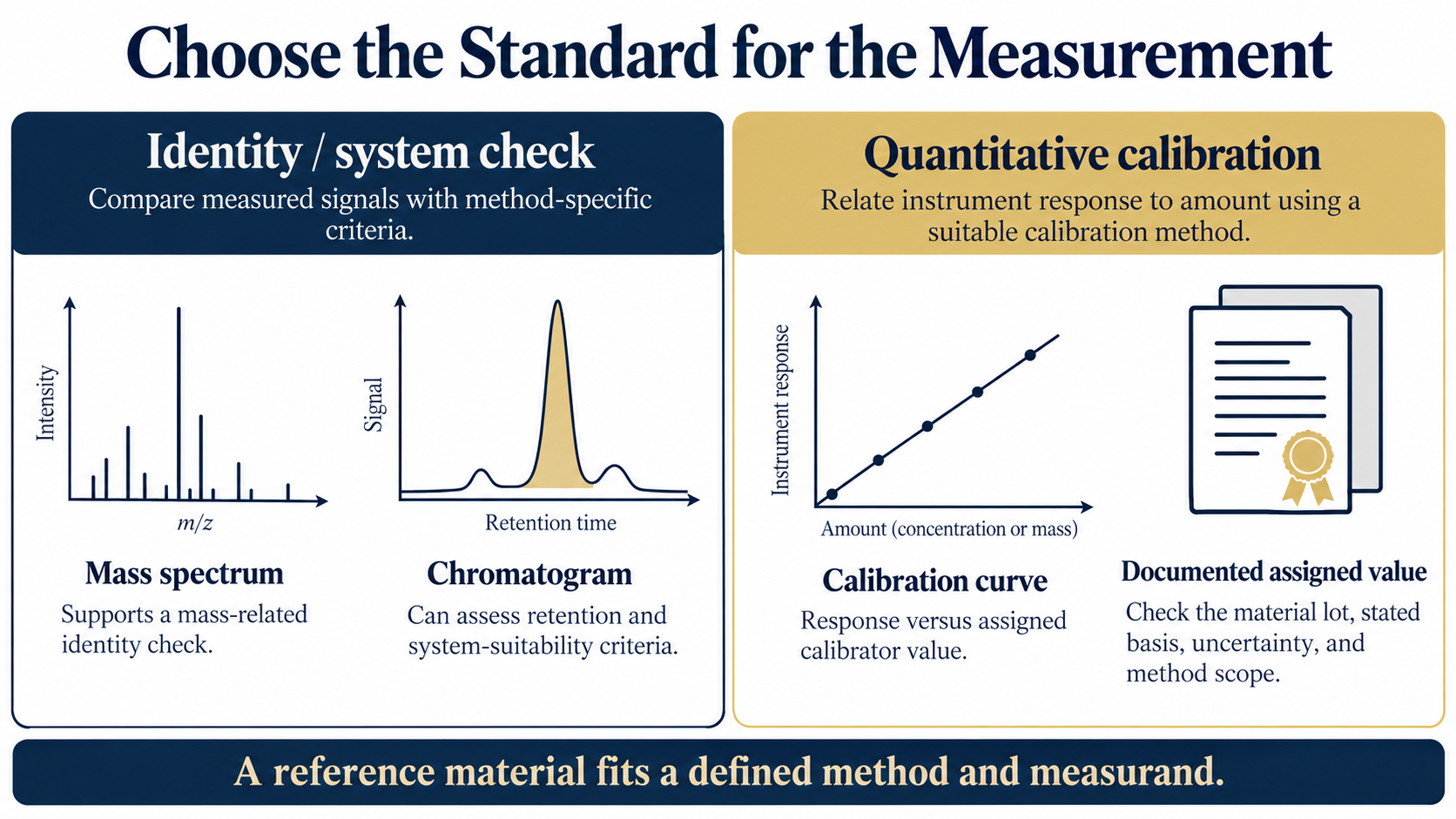
Choose the material for the measurement you need
Identity and system checks
A material used to check identity or system suitability can help assess specified signals or method criteria. It does not, by itself, establish the amount of peptide in an unknown sample. The acceptance criteria and interpretation should come from the applicable method or a documented laboratory protocol.
Quantitative calibration
Quantitative calibration needs a material with a value and basis appropriate to the assay. The analytical response is related to the known calibrator values under the method’s defined conditions. A reference material cannot compensate for an unsuitable method, an unrepresentative sample matrix, or calibration outside the range supported by the method.
Internal standards in mass spectrometry
In peptide mass-spectrometry workflows, a stable-isotope-labeled peptide may serve as an internal standard. It can support comparison of signal behavior within a defined assay, but it does not automatically establish the absolute concentration of an analyte or validate the whole workflow. The 2016 Clinical Chemistry recommendations discuss how peptide calibrators and internal standards must be characterized in the context of the particular assay.
What to check in the documentation
Before relying on a reference material, check that the documentation identifies the material and the lot and supports the measurement you intend to make. Useful details can include:
- Identity: material name and, where applicable, sequence or other unambiguous identifier.
- Lot: the lot number on the container should match the lot in the certificate or accompanying record.
- Purpose: whether it is intended for qualitative use, a specified compendial procedure, system suitability, or quantitative use.
- Assigned value and basis: the stated value, units, basis, and any uncertainty or qualification provided by the supplier.
- Characterization scope: which tests were performed and what the reported result actually measures.
- Handling and stability: supplier-stated storage conditions, expiry or retest information, and any limitations on use after opening or preparation.
A certificate is a record with a defined scope, not a universal guarantee. For example, USP distinguishes its USP Certificates from Certificates of Analysis and says its certificate does not report every test result from the reference-standard evaluation. Likewise, a supplier’s HPLC trace supports only conclusions that the method, detection, integration, and documentation can support. See our guides to reading a peptide COA, HPLC vs. LC-MS analysis, and peptide purity vs. content.
Reference standards do not automatically create traceability
Traceability is a property of a measurement result supported by a documented chain of calibrations or comparisons, with relevant uncertainty information. NIST explains that buying or using a Standard Reference Material does not, by itself, make a user’s later results traceable to NIST. The measurement process, reference chain, and uncertainty at each link matter.
The same practical caution applies when evaluating claims about any reference material: ask what value is assigned, by whom, to which lot, for what measurand, and through what documented chain. Do not infer a traceability claim that the supplier’s record does not make.
Limitations and evidence gaps
Peptides can present analytical challenges related to sequence, impurities, counterions, water content, stability, and method response. A standard characterized for one purpose may not cover every attribute that matters to a different procedure. The USP-authored 2023 review describes orthogonal characterization and value assignment for synthetic peptide reference standards and notes that some sequence features can require additional techniques for full characterization.
For mass-spectrometry assays, the 2016 consensus recommendations are specifically about peptide use in MS-based assays. Their details should not be treated as universal instructions for every analytical platform. A laboratory should interpret standards within the scope of its method, quality system, and applicable requirements.
Frequently asked questions
Is a peptide reference standard the same as a calibrator?
Not always. A reference standard is a characterized material used for a defined purpose. A calibrator is used to relate analytical response to known values in a quantitative method. A particular reference standard may serve as a calibrator only when its assigned value and documentation are suitable for that method.
Does a high HPLC area percentage prove peptide content?
No. HPLC area percentage reflects detected chromatographic signal under the stated method. It does not automatically measure water, counterions, residual solvents, or the mass fraction of peptide in the material.
Can I assume a peptide reference material is 100%?
No. Use only a value stated for the exact material and lot, and follow the stated basis and scope. USP’s special rule for a quantitative USP compendial procedure should not be generalized to other uses.
Does using a NIST reference material make my result NIST-traceable?
Not automatically. NIST says traceability of a user’s result requires a documented chain of calibrations or comparisons and associated uncertainty; purchasing or using an SRM alone is not sufficient.
What should I match before using a standard?
Match the material identity and lot, intended use, measurand, method, assigned value and basis, and the documentation’s stated limitations. Confirm that the method and laboratory protocol support the conclusion you plan to report.
Primary sources and further reading
- McCarthy D, et al. Reference Standards to Support Quality of Synthetic Peptide Therapeutics. Pharmaceutical Research. 2023;40(6):1317–1328. Published online March 22, 2023. DOI: 10.1007/s11095-023-03493-1. Supports the discussion of characterization, value assignment, vial consistency, and stability considerations.
- Hoofnagle AN, et al. Recommendations for the Generation, Quantification, Storage, and Handling of Peptides Used for Mass Spectrometry-Based Assays. Clinical Chemistry. 2016;62(1):48–69. DOI: 10.1373/clinchem.2015.250563. Scope: peptide standards and assay considerations for mass-spectrometry-based workflows.
- United States Pharmacopeia. USP Reference Standard Certificates and Assigned Values. Policy statement effective November 1, 2020, until superseded. Supports the scope of USP Certificates and the lot-specific assigned-value discussion.
- National Institute of Standards and Technology. Metrological Traceability: Frequently Asked Questions and NIST Policy. Accessed October 24, 2026. Supports the distinction between purchasing a reference material and establishing traceability for a measurement result.
- United States Pharmacopeia. Using USP Reference Standards. Official user guide. Supports the distinction between a USP RS and materials used beyond its associated compendial applications.
Related Peptides Skin research guides
For related quality resources, read our guide to peptide batch testing, browse the Research Resources hub, or explore the Research Methods & Quality category.
Research-use-only boundary: This article is for laboratory research and educational purposes only. Not for human or veterinary use.