


A certificate of analysis (COA) summarizes selected analytical results for a sample or production lot. To read one carefully, match the document to the material, identify what each test measured, and note the method, date, and limitations. A COA supports documentation review; by itself, it does not establish clinical safety, effectiveness, regulatory approval, or suitability for any use outside the document’s stated scope.
What a peptide COA can and cannot tell you
A COA is a test report tied to a sample or batch. It can document the identity information supplied to the laboratory, the methods used, and the results reported for that sample. Its value depends on traceability and enough detail to interpret those results.
Read the report as evidence about a defined sample
First identify the sample name, sample or lot number, dates, laboratory, methods, and reported results. A COA is not automatically an independent guarantee about every unit in a shipment, nor does it prove claims the laboratory did not test.
Keep the scope of each result visible
Ask what material the lab received, which tests were performed, and which properties the report covers. Do not extend a result beyond the stated sample, method, or measurement.
Match the COA to the product and lot
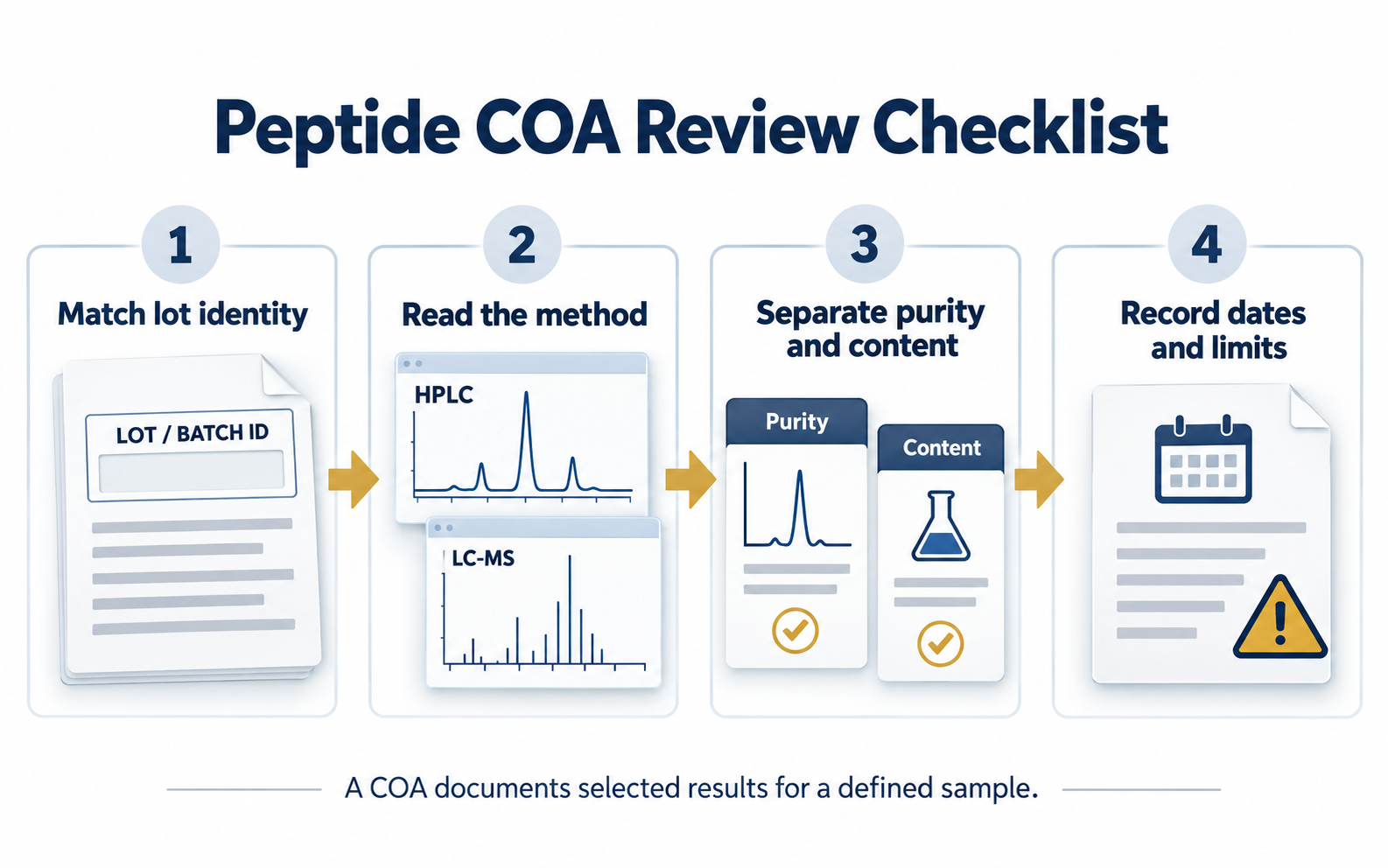
Compare the product name and lot or batch identifier on the COA with the corresponding product record and label. Confirm the match before interpreting a purity value or other result.
Check identity details consistently
Where provided, compare the compound name, sequence or other identifier, expected molecular mass, and sample description. A difference may have a simple explanation, but it should be resolved with the report issuer rather than guessed.
Use the lot number for traceability
A lot number links a document to a defined batch. A generic report with no sample identifier is harder to connect to the material being reviewed. If the COA and product record show different identifiers, request clarification.
Understand the analytical methods listed
A method should be relevant to the property being reported. The method name alone is not enough: look for sample identity, conditions or method reference, units, and any stated limits that help explain the result.
Chromatography and reported purity
High-performance liquid chromatography (HPLC) separates components under specified conditions. A report may express a chromatographic result as area percent. That value describes detector response under the method; it is not automatically the same as the mass fraction or total amount of material in a container.
Do not treat one percentage as a complete quality profile
Interpret the value together with the method, detector, integration, sample preparation, and other available identity or content measurements. See our guide to peptide purity versus content for the distinction.
Mass spectrometry and identity evidence
Mass spectrometry can support molecular-mass or identity assessment when the method and expected analyte are appropriate. It answers a different analytical question from a chromatographic purity estimate. One technique does not replace all other characterization.
Interpret reported results with context
Read each result with its units, method, acceptance criteria if stated, and notes. Check whether the report gives a measured value, a specification, or a conclusion. These are not interchangeable.
Separate purity, content, and identity
Identity asks whether the measured characteristics are consistent with the expected material. A chromatographic purity estimate describes the separated signal under its method. Content or assay addresses how much of a specified substance is present using its own measurement basis. A report should make clear which property each number represents.
Look for missing context before drawing a conclusion
If the report omits units, method details, sample identifiers, or an explanation of an unusual result, treat that as an information gap. Do not fill it with assumptions based on a product page or another lot’s report.
Review dates, laboratory details, and limitations
Check the test date, report date, issuing laboratory or responsible party, and any reference standard or method identifier shown. Look for corrections, deviations, and limitations. When important information is missing, contact the report issuer for clarification.
Check document consistency and provenance
Use contact details obtained independently when verifying a report. Compare the COA’s identifiers and dates with the associated records. A logo or polished layout alone does not establish who performed the analysis.
Research-use-only context
Research-use-only wording describes an intended context; it does not certify safety or clinical performance. The FDA guidance linked below specifically addresses RUO/IUO labeling for in-vitro diagnostic products, so its scope should not be generalized to every research material.
Selected references
- United States Pharmacopeia researchers. Reference Standards to Support Quality of Synthetic Peptide Therapeutics. PubMed record. This review discusses reference standards and analytical characterization for synthetic peptide therapeutics.
- U.S. Food and Drug Administration. Distribution of In Vitro Diagnostic Products Labeled RUO or IUO. Guidance for in-vitro diagnostic products; scope-specific.
Frequently asked questions about peptide COAs
What is a peptide COA?
A certificate of analysis is a report of selected analytical results for a defined sample or lot. The document should identify what was tested and which methods and results it covers.
What details are useful on a COA?
Useful details include sample identity, lot or batch identifier, test and report dates, named methods, units, results, laboratory or responsible party, and relevant limitations.
Does a COA prove a product is safe or effective?
No. A COA reports specific tests on a sample. It does not establish clinical safety, effectiveness, regulatory approval, or suitability for human or veterinary use.
Does a high HPLC area percentage mean the same percentage by weight?
Not necessarily. Area percentage reflects detector response under the stated chromatographic conditions. It should not automatically be interpreted as mass fraction or total content.
Are HPLC and mass spectrometry interchangeable?
No. They can provide different types of analytical evidence. Interpret each result in light of the method and the property it was designed to assess.
Why does the lot number matter?
It helps connect a report to a specific sample or production batch. Without a matching identifier, traceability is less clear.
Can one COA apply to every batch of the same product?
Do not assume so. Check whether the report identifies the specific sample or lot under review and ask the issuer if the relationship is unclear.
What if the product name differs slightly from the COA?
Pause interpretation and ask the report issuer or responsible supplier to explain the difference. Do not assume two labels refer to the same material.
What if the report does not name a method?
The result may be difficult to assess. Request the method name or method reference and the context needed to understand the measurement.
Does a COA need a test date?
A test date helps readers understand when the analysis was performed and connect the result to the relevant sample record. Ask for clarification if the date is absent.
How can I verify who issued a COA?
Use independently sourced contact information to ask the laboratory or issuer whether the report identifier is genuine and what sample it covered.
Where can I learn about related methods?
Read our guides to HPLC versus LC-MS, peptide batch testing, and the peptide research and COA resource hub.
Educational information for research-documentation literacy only. It is not medical advice, product verification, or a recommendation for human or veterinary use.


6 Comments