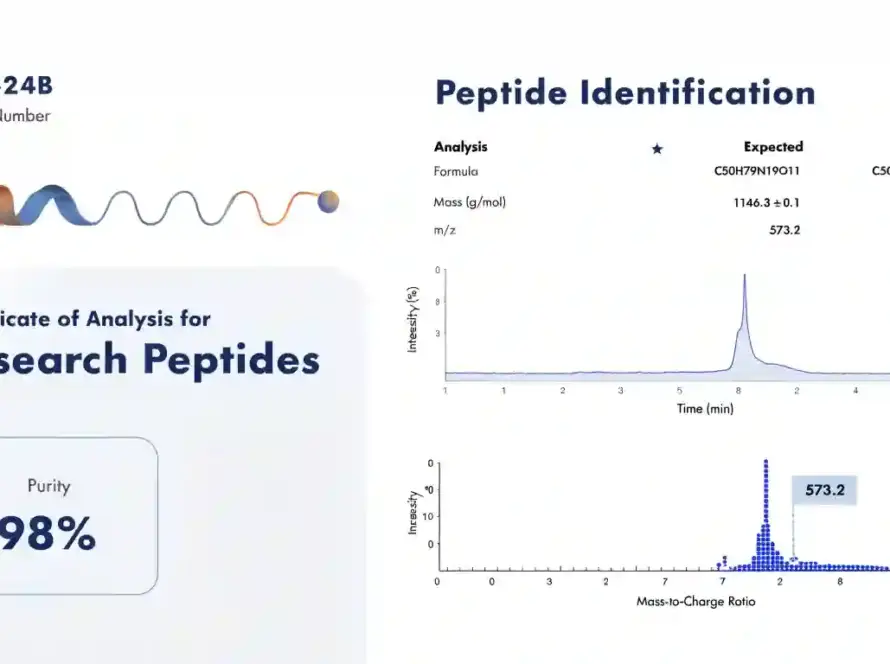


AOD-9604 research focuses on a peptide fragment derived from a region of human growth hormone. The proposed biological rationale has been examined in laboratory and animal models, with human research also reported. Evidence must be assessed by study type rather than inferred from the parent hormone.
The Fragment and the Research Question
AOD-9604 is commonly described as corresponding to residues 176–191 of human growth hormone with an added tyrosine. Researchers have asked whether this fragment has distinct metabolic activity. Structural similarity to a hormone does not show that it reproduces the hormone’s effects.
Preclinical Findings
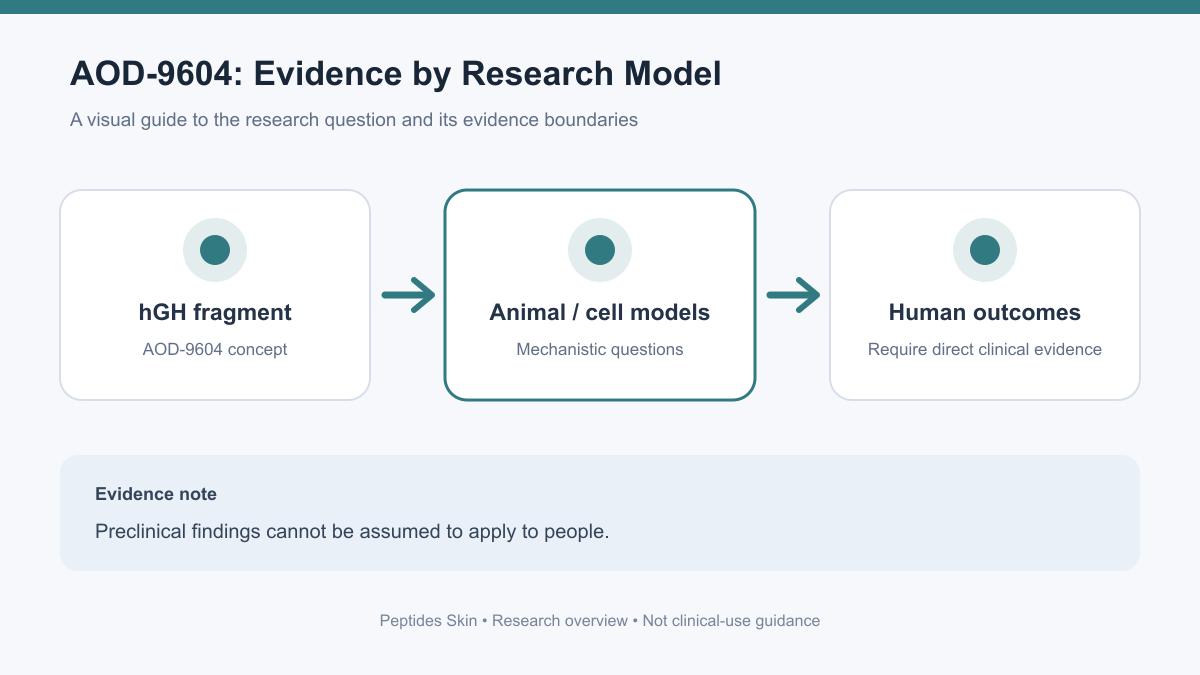
Animal studies and cell experiments can investigate mechanisms, tissue responses, and hypotheses. They help guide questions for later research, but models do not establish efficacy or safety in people. Note the species, methods, sample size, and endpoint when reading these reports.
Human Evidence and Trial Design
Human studies need a suitable comparator, adequate duration, prespecified outcomes, and transparent reporting. A study that does not demonstrate a meaningful endpoint should not be reframed as proof based on a plausible mechanism. Distinguish exploratory measurements from primary outcomes.
Why Broad Claims Need Caution
Evidence for a fragment is not interchangeable with evidence for full-length growth hormone, and one product’s data cannot validate other sources. Independent replication and clear formulation data matter. Readers should treat promotional summaries as claims to verify against the original paper.
Frequently Asked Questions
Is AOD-9604 the same as growth hormone?
No. It is a fragment-derived peptide, not full-length human growth hormone.
Do animal results establish effects in people?
No. They support hypotheses that require human research.
Does a mechanism prove efficacy?
No. Efficacy requires appropriate clinical outcome evidence.
Catalog context: For a separate catalog reference related to fragment research, review the AOD-9604 research-use-only catalog record for listed formats and research-use-only documentation. Availability and documentation may change, so match the exact product record to the applicable laboratory workflow.
References
Explore our Peptides Skin research resources for evidence-reading guidance.