


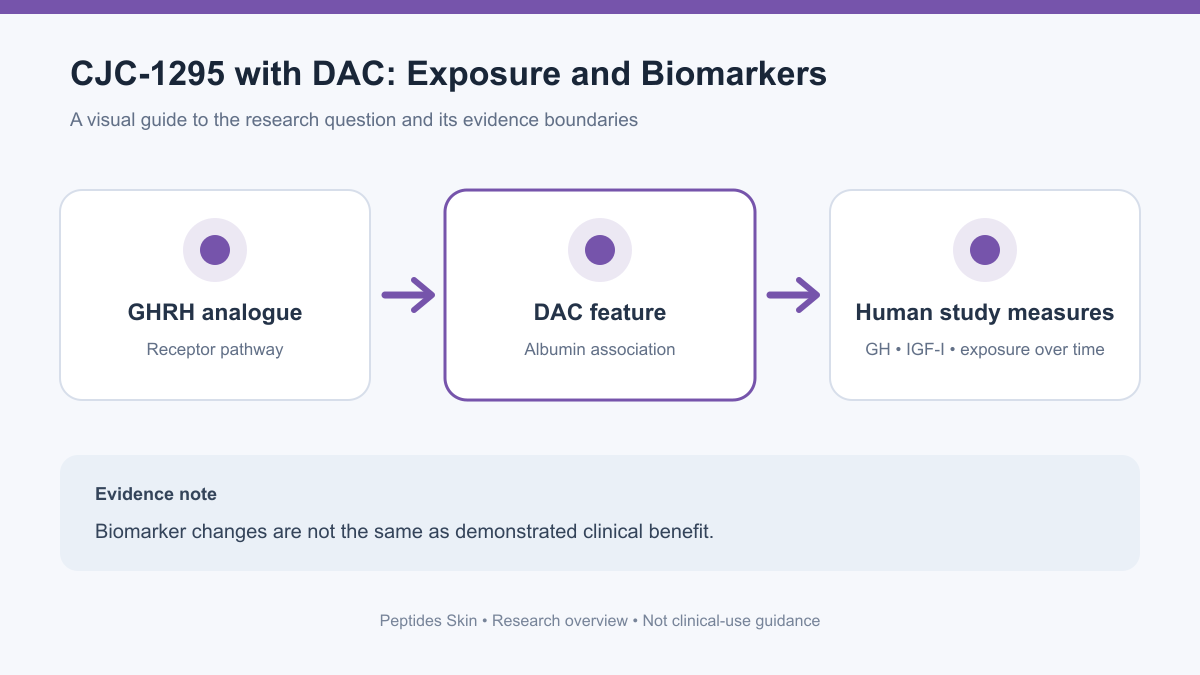
CJC-1295 with DAC research examines a synthetic growth-hormone-releasing hormone analogue modified with a drug-affinity complex. The modification was designed to promote reversible albumin binding and extend exposure. Molecular design explains what investigators test; it does not by itself establish clinical benefit or safety.
What the DAC Modification Does
Albumin binding can affect how long a molecule remains in circulation. Researchers can study that question through pharmacokinetic measurements. A longer exposure profile is a property to measure, not evidence that a product improves health outcomes.
Structure and pharmacology
Keep the studied molecule distinct from other compounds sharing a similar name. The paper’s material identity, assay, and protocol determine what its results can support.
What Human Research Measured
An early controlled human study examined growth hormone and IGF-1 concentrations after CJC-1295. These measurements provide information about pharmacology under the study conditions. They do not establish effectiveness for a disease or validate the composition of commercial products.
How to Read Hormone Data
Hormone values depend on sampling time, assay methods, baseline variation, and study design. Check the comparator, participant numbers, follow-up, confidence intervals, and adverse-event reporting. A biomarker change is not automatically a patient-important outcome.
Regulatory and Evidence Context
FDA committee materials discuss the evidence and quality questions relevant to peptide substances. Research-use wording does not mean that a compound is an FDA-approved medicine. Any clinical claim should match the exact tested formulation and published evidence.
Frequently Asked Questions
What does DAC mean?
It refers to a modification intended to promote reversible albumin binding and longer exposure.
Does longer exposure prove a health benefit?
No. Pharmacokinetic findings and clinical outcomes are different evidence types.
Can early hormone studies establish long-term safety?
No. Sample size and follow-up limit what these studies can conclude.
Catalog context: For a current catalog reference related to GHRH research, review the CJC-1295 with DAC research-use-only catalog record for listed formats and research-use-only documentation. Availability and documentation may change, so match the exact product record to the applicable laboratory workflow.