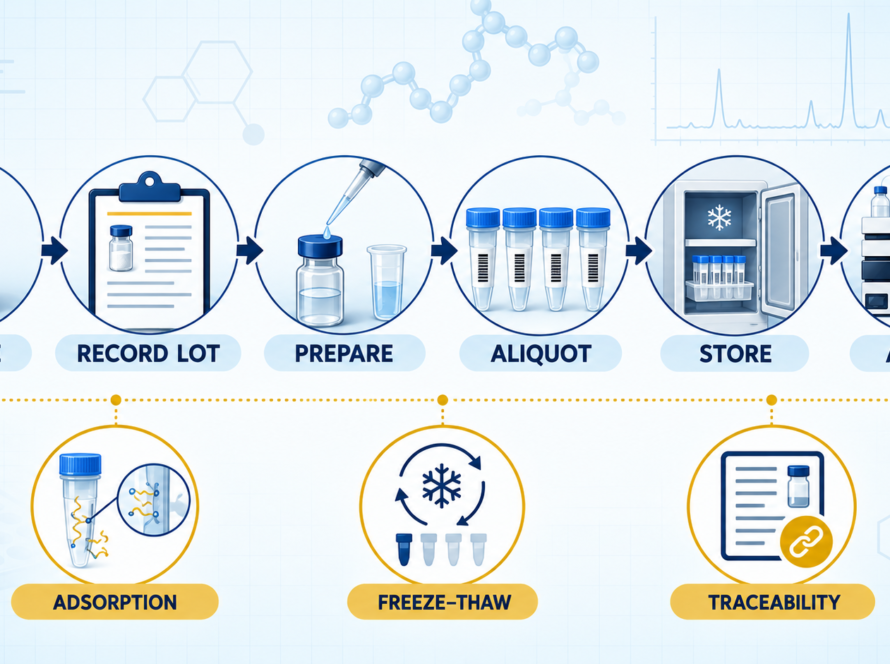


Short answer: Cold-chain shipping is a documented quality process, not a universal promise that every research peptide must travel at one fixed temperature. The appropriate shipping condition depends on the peptide sequence, physical form, packaging, route, season, and product-specific stability evidence.
Why shipping belongs in peptide quality review
A research material can leave a controlled storage location in an acceptable state and still experience avoidable risk during transit. Heat exposure, repeated temperature cycling, moisture, condensation, damaged insulation, and delivery delays may affect the condition of a lyophilized material or solution. The absence of visible damage does not establish chemical integrity.
For that reason, shipping records should be treated as part of the material’s traceability record. A receiving team should be able to connect the shipment, the vial or container, the lot number, the Certificate of Analysis (COA), and any temperature-monitoring record.
Lyophilized powder and solution are different shipping states
Lyophilized peptides contain little available water and are generally more stable than the same material in solution. However, stability remains sequence- and formulation-specific. A dry vial, a reconstituted solution, and a frozen aliquot should not be treated as interchangeable shipping states.
Research guidance from Bachem and other analytical references emphasizes that storage and transit decisions depend on the material and the intended laboratory method. This is why a general internet temperature rule cannot replace product-specific documentation or a validated quality procedure.
What a documented cold-chain shipment should include
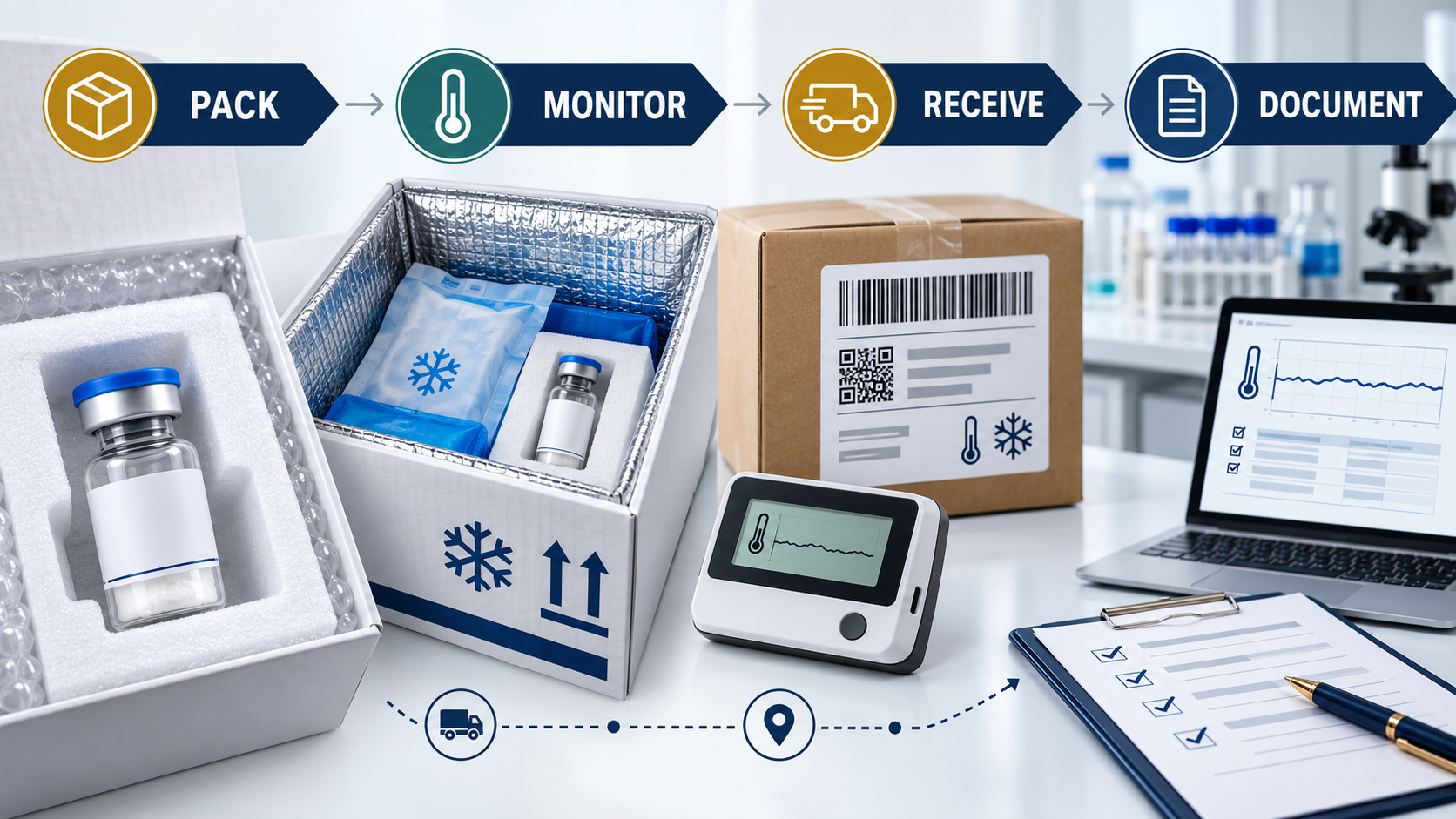
Pack-out information
The shipment record should identify the material state, packaging configuration, dispatch date, expected route, and any coolant or insulation used. The purpose is not to create a marketing claim; it is to make the transport condition reviewable.
Monitoring information
Where temperature monitoring is used, the record should identify the indicator or data logger, its status, and the time window covered. A statement that a package was “shipped cold” is weaker than a traceable record connected to a specific shipment and lot.
Route and delay information
Weekend holds, carrier delays, damaged packaging, and unexpected rerouting are relevant observations. They do not automatically prove that a material failed, but they may create a reason for documented quality review.
Lot-linked documentation
The lot or batch identifier on the shipment should match the vial, product record, and COA. A temperature record that cannot be linked to the material being reviewed has limited value.
How laboratories can investigate a temperature excursion
A temperature excursion should be treated as an investigation trigger rather than an automatic pass or automatic rejection. The decision should use product-specific stability evidence, the material’s physical state, the length and severity of the event, packaging observations, and the laboratory’s quality system.
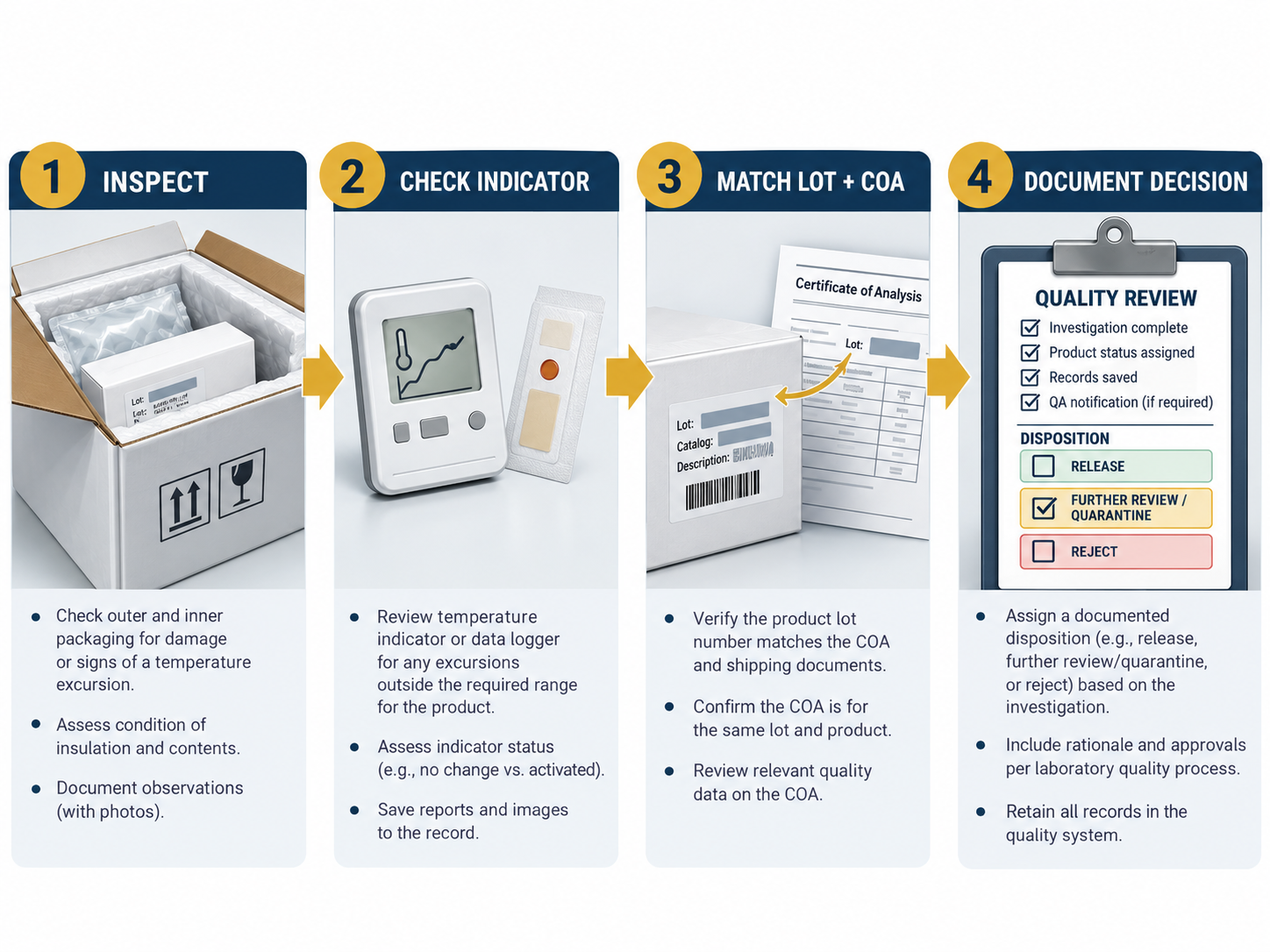
1. Inspect and record the package
Record the outer and inner packaging, visible damage, condensation, coolant condition, and the state of the vial or container. Photographs and a receipt timestamp can preserve useful evidence.
2. Review the indicator or logger
Check whether the monitor shows an excursion and identify the covered time period. The indicator is evidence about the shipment; it is not, by itself, a complete stability study.
3. Match the lot and COA
Confirm that the product name, lot number, and shipment documents correspond to the same material. For documentation guidance, see our COA, HPLC, and mass-spectrometry checklist.
4. Document the disposition
Record the investigation, the evidence reviewed, the responsible decision-maker, and the final disposition under the laboratory’s quality procedure. Possible dispositions may include release, further review, or quarantine pending additional evidence. The decision should be justified and traceable.
What stability guidance can and cannot establish
Stability guidance can help laboratories design questions about temperature, humidity, light, container closure, degradation pathways, and analytical methods. It does not create a universal shelf life for every peptide or authenticate a separate online batch.
The EMA guideline on synthetic peptides emphasizes justified stability studies, product-relevant conditions, and analytical methods capable of detecting degradation. Published laboratory guidance also notes that moisture, sequence composition, solution state, and repeated temperature changes can alter stability. These sources are useful context, but the evidence must remain matched to the material and conditions actually studied.
Common interpretation errors
- Assuming every peptide requires the same shipping temperature.
- Treating a cold pack or temperature label as proof of chemical integrity.
- Ignoring the difference between lyophilized material and solution.
- Accepting a shipment record that cannot be matched to the lot or COA.
- Turning a general stability statement into a guaranteed shelf life.
- Using appearance alone to establish identity, purity, sterility, or biological activity.
Related Peptides Skin research resources
- How to Store Lyophilized Peptides: Stability, Light, and Moisture
- Peptide Reconstitution Guide: Labels and Safety
- Research Resources, COA Guides, and Laboratory Methods
Frequently asked questions
Does every research peptide need cold-chain shipping?
No. The appropriate condition depends on the peptide, its physical form, packaging, route, and product-specific stability evidence.
Does a temperature excursion automatically mean the material failed?
No. It creates a quality-investigation question. The decision requires documented evidence and a justified review under the laboratory’s procedure.
Is a lyophilized peptide the same as a peptide in solution for shipping?
No. The physical state changes the stability context, so the two states should not be treated as interchangeable.
What should be matched when a shipment arrives?
Match the product identity, lot or batch number, vial or container, COA, shipping record, and any temperature-monitoring information.
Can a COA prove that a shipment stayed within its required condition?
No. A COA reports defined analytical results for a sample or lot. Shipping-condition evidence comes from transport records and receiving documentation.
What does this article not establish?
It does not establish a universal temperature range, shelf life, product release decision, sterility, biological activity, or suitability for human or veterinary use.
Research-use-only boundary
For laboratory research and educational purposes only. Not for human or veterinary use. This article does not provide dosing, administration, treatment, diagnosis, or personal-use instructions.
Sources
- European Medicines Agency: Guideline on the Development and Manufacture of Synthetic Peptides
- Bachem: Handling and Storage Guidelines for Peptides
- Peptide Biosciences: Cold-Chain Peptide Shipping Explained
- ZePeptide: Cold-Chain Temperature Excursions for Research
- PMC: Regulatory Guidelines for the Analysis of Therapeutic Peptides and Proteins