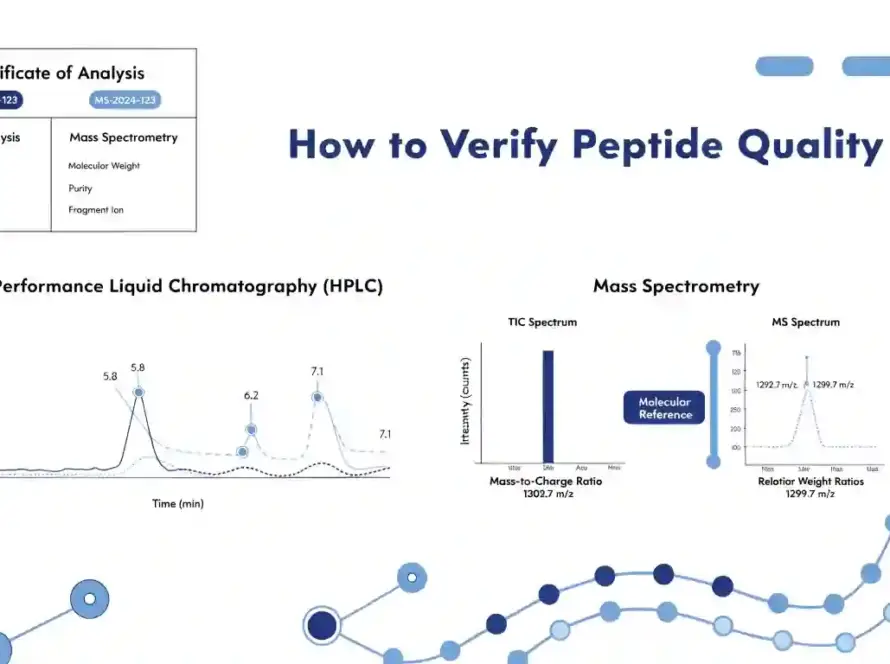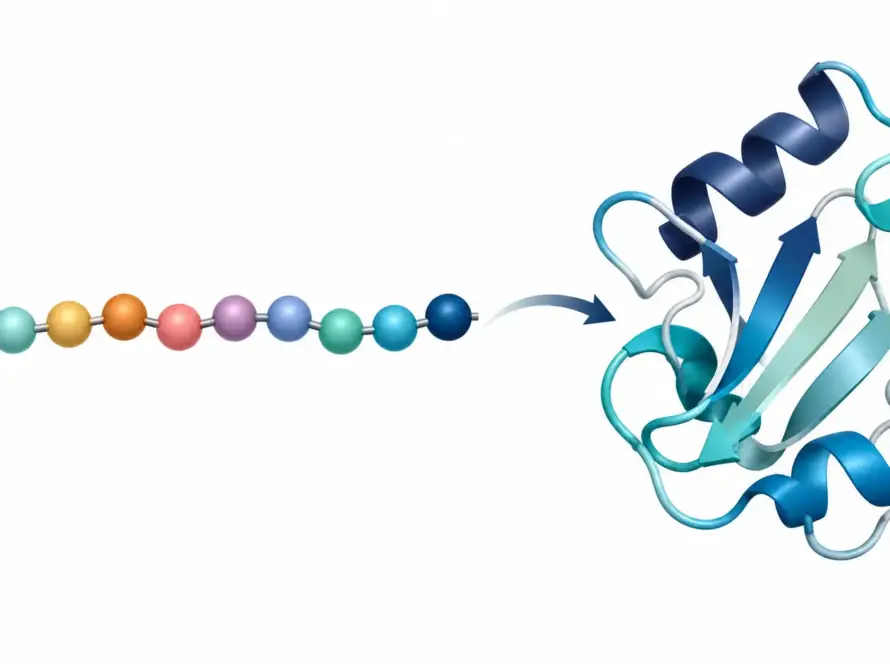


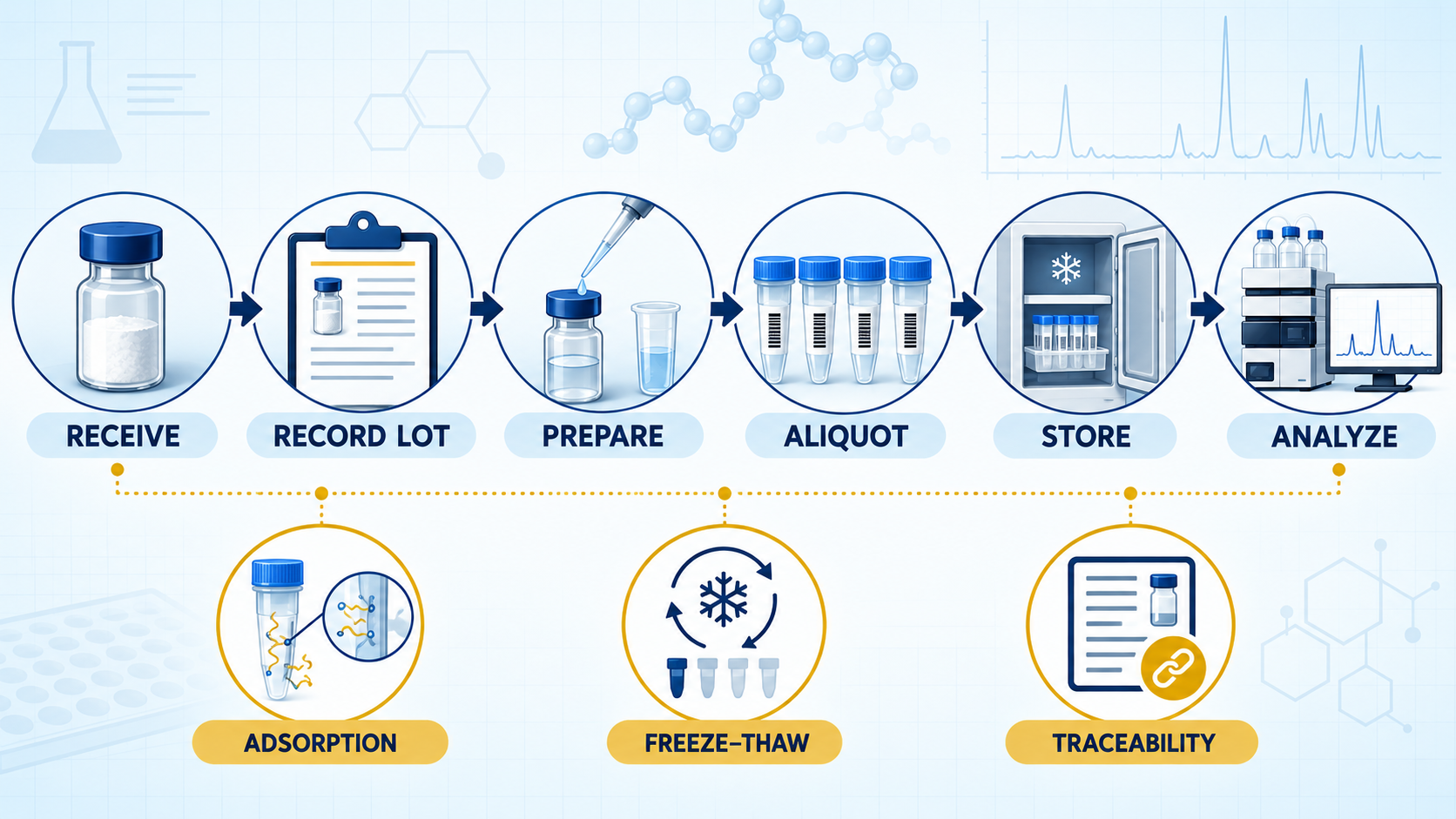
Short answer: Peptide sample preparation should preserve the identity of the material, minimize uncontrolled adsorption and repeated temperature cycling, and leave a clear record from the received lot to the analytical result. A documented aliquot plan can reduce avoidable variability, but it does not replace method validation or appropriate identity and purity testing.
Why sample preparation deserves its own control plan
Peptides can interact with containers, surfaces, buffers, and particulates. Preparation history can also change the comparability of samples even when the nominal material name is unchanged. A control plan makes those risks visible and gives the laboratory a consistent record for review.
The aim is not to promise a particular result. It is to protect the connection between the material selected for research and the measurement that is ultimately reported.
Start with the research question and method
Define the endpoint before choosing a preparation workflow. Identity confirmation, chromatographic purity, apparent stability, binding readouts, and other analytical questions may require different matrices, concentrations, container materials, and handling controls. The method should specify what is known, what is exploratory, and which observations would qualify a run.
Use the method’s validated conditions
Follow the documented laboratory method for solvent, matrix, mixing, hold time, temperature, and instrument compatibility. If a condition is changed, record it as a deviation or method-development experiment rather than silently treating it as equivalent.
Keep the sample identity independent from the expected outcome
Assign a stable sample identifier before analysis. Link it to the product description, lot or batch, receipt record, preparation date, analyst, and run file. This helps prevent mix-ups and keeps interpretation separate from assumptions about what the sample should show.
Aliquoting and adsorption control
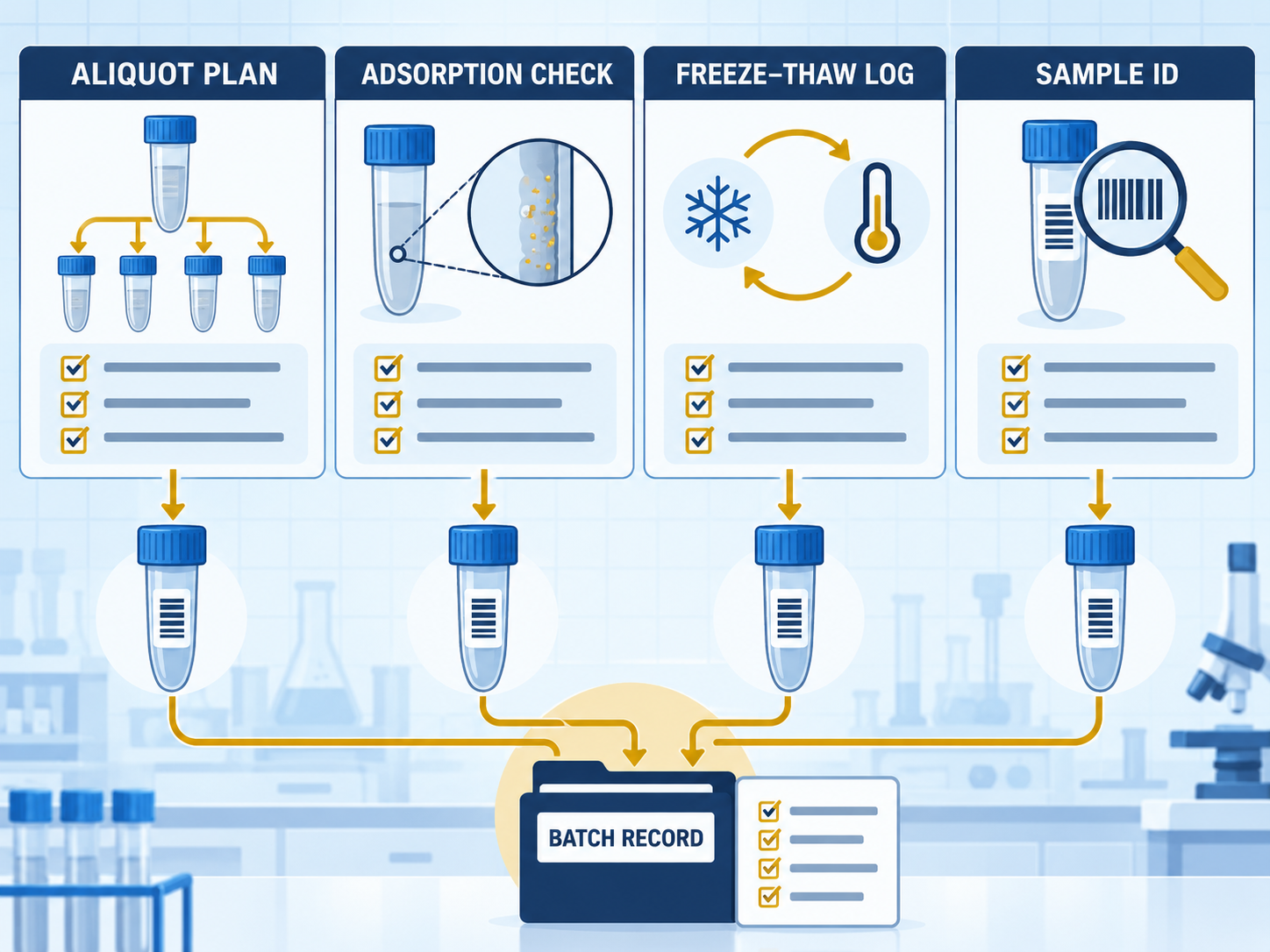
Aliquoting divides a prepared sample into smaller, labeled portions so that a working portion can be used without repeatedly opening or cycling the full stock. The number and volume of aliquots should be justified by the study plan and by the minimum amount required for the intended measurements.
Why surface interactions matter
Adsorption to tubes, plates, filters, or other surfaces can change the recovered amount or apparent signal. The effect depends on the peptide, matrix, surface, contact time, and mixing history. It should be treated as an analytical variable, not assumed away because a container is described as low-binding.
Document the container and contact path
Record the container type, closure, filter or transfer materials, and any preconditioning or recovery check required by the method. When surface loss is plausible, a small comparative assessment can help determine whether container choice needs to be controlled.
Freeze–thaw history and storage records
Repeated temperature cycling can be a source of variation for some materials and methods. A laboratory record should capture storage location, date and time of removal, return to storage where applicable, and the number of cycles or a clear reason why a cycle occurred.
Use a simple cycle log
A cycle log can be a field in the sample register, a controlled worksheet, or an electronic laboratory record. The important point is that the record stays attached to the sample identifier and is available during data review.
Do not infer stability from storage alone
A storage label or a single observation does not establish long-term stability. Stability conclusions require a defined study design, suitable time points, an appropriate assay, and documented acceptance criteria. See the Peptides Skin guide to peptide stability testing for a broader evidence framework.
Prepare a lot-linked sample record
At minimum, preserve the material name, internal sample ID, lot or batch number, source, receipt condition, storage location, preparation date, operator, container, method version, and instrument run identifier. Attach the relevant COA and analytical files rather than relying on a free-text note.
Use labels that survive export
Sample identifiers should remain readable in plate maps, chromatograms, instrument exports, and review copies. Avoid labels that depend only on screen position or an analyst’s memory.
Record deviations and failed preparations
A failed preparation, unexpected hold time, or damaged container is part of the evidence trail. Record what happened and how the sample was handled. Do not replace the record with a clean summary that hides the deviation.
Review readiness before analysis
Before starting a run, confirm that the sample ID, lot record, method version, control set, storage history, and container path are present. Review blank and control requirements alongside the sample plan. If a required field is missing, pause for clarification or qualify the run before interpretation.
Common sample-preparation mistakes
- Using one untracked stock through many unrelated runs.
- Re-labeling tubes without preserving the original sample ID.
- Assuming a “low-binding” surface eliminates adsorption risk.
- Leaving freeze–thaw history to memory.
- Reporting an apparent stability change without defining the assay and acceptance criteria.
- Linking a result to a product name but not to the actual lot or prepared sample.
Related Peptides Skin resources
Continue with how to read a peptide COA, HPLC versus LC-MS peptide analysis, peptide research controls and batch traceability, and the Peptides Skin research resources library.
FAQs
What is aliquoting in peptide research?
Aliquoting is dividing a prepared research sample into labeled portions so the working portion can be used without repeatedly opening or cycling the full stock. The plan should be documented and linked to the sample record.
Why can adsorption affect a peptide assay?
Some peptides can interact with container or transfer surfaces. That interaction may change recovery or apparent signal, so surface materials and contact conditions may need to be assessed for the method.
Should every freeze–thaw event be recorded?
Yes. A simple record of removal, return, and cycle count or reason helps reviewers distinguish a documented history from an assumption about storage.
Does a COA prove that a prepared sample is stable?
No. A COA describes the supplied material and its reported tests. Stability of a prepared sample requires a fit-for-purpose study design and an assay that measures the relevant endpoint.
What should be linked to a sample ID?
Link the sample ID to the source and lot, receipt condition, preparation record, storage history, container path, method version, and instrument file. This creates a traceable chain for review.
What does this article not establish?
It does not establish human or veterinary safety, dosing, administration, diagnosis, treatment, clinical efficacy, or personal-use suitability.
Research-use-only boundary
For laboratory research and educational purposes only. Not for human or veterinary use.
Sources and documentation
- U.S. FDA Pharmaceutical Quality Resources
- ICH Quality Guidelines
- European Medicines Agency guideline on development and manufacture of synthetic peptides
- PubMed Central research archive
Editorial evidence and source review
How this article was prepared: Peptides Skin Editorial reviewed the topic against the linked primary literature, standards, and official sources available on 26 October 2026. The article separates measured observations from proposed mechanisms and inference. Conclusions apply only to the material, model, method, and conditions described here.
Evidence boundary: A research result, certificate, analytical signal, or preclinical finding should not be generalized to a different batch, formulation, study population, or personal-use context. Readers should consult the original source for its full methods and limitations.
Primary and authoritative source pathways
Editorial scope: this page is for laboratory research education and does not provide medical, dosing, administration, treatment, diagnosis, or personal-use instructions.