

Peptides Skin • Compound evidence profile
A guide to tirzepatide research: receptor biology, selected human trials, and the limits that matter when interpreting the evidence.
Start with the study question, then follow the primary publication or one of our focused explainers. This profile connects the evidence; it does not turn a trial result into a claim about an independently supplied material.
Evidence and links reviewed: October 25, 2026. Selected studies from 2018–2025; this is a reading guide, not a systematic review.
Tirzepatide research identity and mechanism
Tirzepatide, developed as LY3298176, is a peptide with activity at the glucose-dependent insulinotropic polypeptide (GIP) receptor and glucagon-like peptide-1 (GLP-1) receptor. The foundational study examined receptor signaling in cells, metabolic responses in mice and early human observations. These are distinct kinds of evidence, each answering a different question. [1]
Ask whether a response occurs in a defined assay. Receptor expression, controls, readout and concentration range affect interpretation.
Connect a proposed pathway with whole-organism observations. Species and experimental conditions limit transfer to humans.
Estimate outcomes and adverse events in a defined population. The studied product, comparator and follow-up remain part of the conclusion.
What selected published studies show
Read each row as a separate research question. A shared compound name does not make the populations, endpoints or study materials equivalent.
On a small screen, swipe the study table sideways.
| Study | What was studied | How to interpret it |
|---|---|---|
| Discovery study Coskun et al., 2018 | Cell assays, mouse experiments and early human research characterized dual-receptor activity. [1] | The mechanistic findings provide a rationale for subsequent trials. They do not independently establish long-term clinical outcomes. |
| SURPASS-2 Frías et al., 2021 | A 40-week comparison with semaglutide in adults with type 2 diabetes, with HbA1c change as the primary endpoint. [2] | The diabetes population and specified comparator define the comparison. It is not the same question as an obesity trial without diabetes. |
| SURMOUNT-1 Jastreboff et al., 2022 | A 72-week placebo-controlled trial in 2,539 adults with obesity or overweight and a weight-related complication, excluding diabetes, reported greater weight reductions with tirzepatide. [3] | Group results describe this population and protocol. Adverse events and treatment discontinuations must be considered alongside efficacy. |
| SURMOUNT-OSA Malhotra et al., 2024 | Two 52-week trials in adults with obesity and moderate-to-severe obstructive sleep apnea measured change in the apnea-hypopnea index. Baseline positive-airway-pressure use differed between trials. [4] | The breathing endpoint and the two trial populations matter. This study design cannot be replaced by a general weight-change comparison. |
| SURMOUNT-5 Aronne et al., 2025 | A 72-week, open-label comparison in adults with obesity without diabetes reported greater average body-weight reduction with tirzepatide than semaglutide. [5] | This is a direct comparison within its protocol. Its open-label design, population and comparator regimens must accompany any headline conclusion. |
Evidence limits, stability and documentation
A useful comparison starts with the population, study material, comparator, measured endpoint, follow-up and handling of missing observations. An outcome in a trial is not automatically transferable to another population, formulation or research lot. Many pivotal studies cited here were industry funded; read their disclosures and analysis plans as part of the appraisal.
Drug elimination in the body does not establish the shelf life of a powder or solution. Stability claims require material-specific methods, conditions and time points. The FDA prescribing information concerns the regulated product described in that label. [6]
For a separate laboratory material, identity, measured content, impurity profile and lot traceability require separate documentation. A purity percentage alone cannot establish sterility, suitability for human use or equivalence to a clinical-trial product.
Continue with the study-generalizability checklist, how to read a peptide COA and purity versus content.
Related Tirzepatide research reading
These Peptides Skin .us articles answer focused questions connected to this profile. They extend the evidence map without repeating the catalog description.
The comparator, trial population and HbA1c endpoint behind this diabetes study.
Read the article →Tirzepatide half-life and pharmacokineticsWhat an elimination half-life describes, and why it cannot establish vial stability.
Read the article →Tirzepatide and sleep apnea: SURMOUNT-OSAThe two trial populations, breathing endpoint and limits of applying the findings.
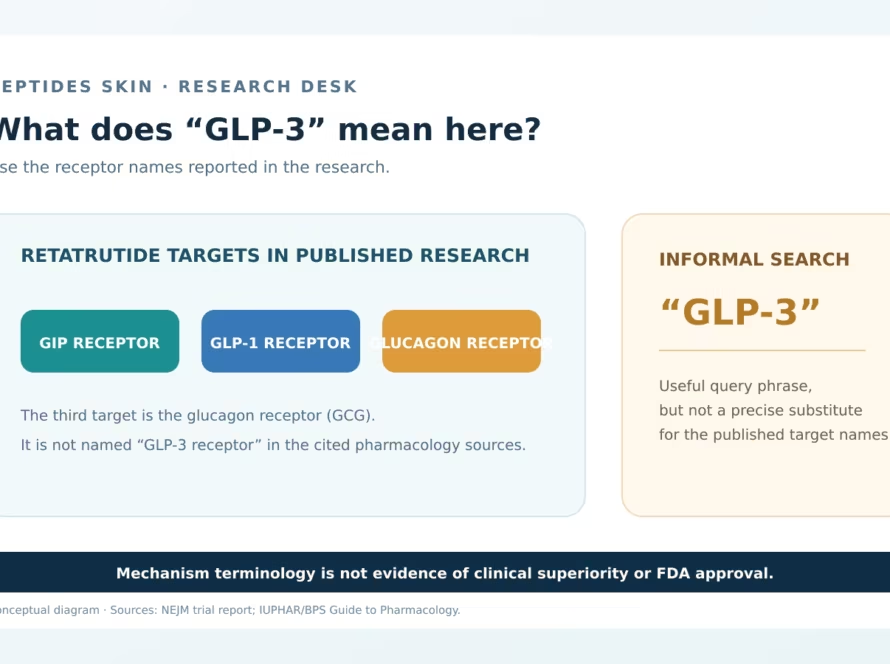
Read the article →Retatrutide vs Tirzepatide: interpreting comparisonsCompare receptor targets and distinguish direct evidence from comparisons across separate trials.
Read the article →Mounjaro and Zepbound: label contextWhy a shared active ingredient does not make the labeled products interchangeable in every context.
Read the article →Tirzepatide and hair-loss reportsHow the article separates adverse-event reporting, possible explanations and unanswered questions.
Read the article →Tirzepatide and fatigue reportsRead label-based adverse-event information without treating group percentages as individual predictions.
Read the article →Tirzepatide research FAQs
What is the difference between mechanism evidence and a clinical result?
A receptor assay tests a defined biological response under experimental conditions. A clinical trial measures outcomes in enrolled people using a specified product and protocol. Mechanistic plausibility alone cannot establish the clinical outcome.
Do SURPASS-2 and SURMOUNT-5 answer the same question?
No. SURPASS-2 studied adults with type 2 diabetes over 40 weeks with HbA1c as the primary endpoint. SURMOUNT-5 studied adults with obesity without diabetes over 72 weeks with body-weight change as the primary endpoint. Their comparator regimens and populations also differed.
Does tirzepatide half-life describe how long a vial remains stable?
No. Elimination half-life concerns the decline of drug concentration in the body. Vial stability requires analytical measurements of a specific material, formulation, container and storage condition over time.
Can a published trial validate a research-use-only vial?
No. The trial characterizes its own study material and protocol. A separate lot needs its own identity, content and quality documentation; clinical equivalence cannot be inferred from the compound name or a purity percentage.
How should this profile and its sources be used?
Use this page to locate a study, identify its design and follow links to detailed explainers. Consult the complete publication and current official product labeling before drawing conclusions. The linked catalog record supplies product information, not clinical validation.
Primary sources and further information
These references support the selected evidence map. Read the full methods and supplementary material; a citation alone is not a quality assessment.
- Coskun T et al. LY3298176, a novel dual GIP and GLP-1 receptor agonist: from discovery to clinical proof of concept. Molecular Metabolism. Published online October 3, 2018. DOI: 10.1016/j.molmet.2018.09.009.
- Frías JP et al. Tirzepatide versus Semaglutide Once Weekly in Patients with Type 2 Diabetes. New England Journal of Medicine. August 5, 2021. DOI: 10.1056/NEJMoa2107519.
- Jastreboff AM et al. Tirzepatide Once Weekly for the Treatment of Obesity. New England Journal of Medicine. July 21, 2022. DOI: 10.1056/NEJMoa2206038.
- Malhotra A et al. Tirzepatide for the Treatment of Obstructive Sleep Apnea and Obesity. New England Journal of Medicine. October 3, 2024. DOI: 10.1056/NEJMoa2404881. See also the published correction, October 17, 2024.
- Aronne LJ et al. Tirzepatide as Compared with Semaglutide for the Treatment of Obesity. New England Journal of Medicine. July 3, 2025. DOI: 10.1056/NEJMoa2416394.
- U.S. Food and Drug Administration. Mounjaro prescribing information, revised August 2026. Product-specific regulatory and pharmacology reference.