

Short answer: Peptide aggregation is the association of individual peptide molecules into oligomers or larger assemblies. In a research laboratory, the useful question is not whether a sample “looks clear,” but whether the material, preparation, time, temperature, container, and analytical method support a reproducible observation. Aggregation signals must be separated from precipitation, particles, method artifacts, and unrelated impurities.
What peptide aggregation means in a research context
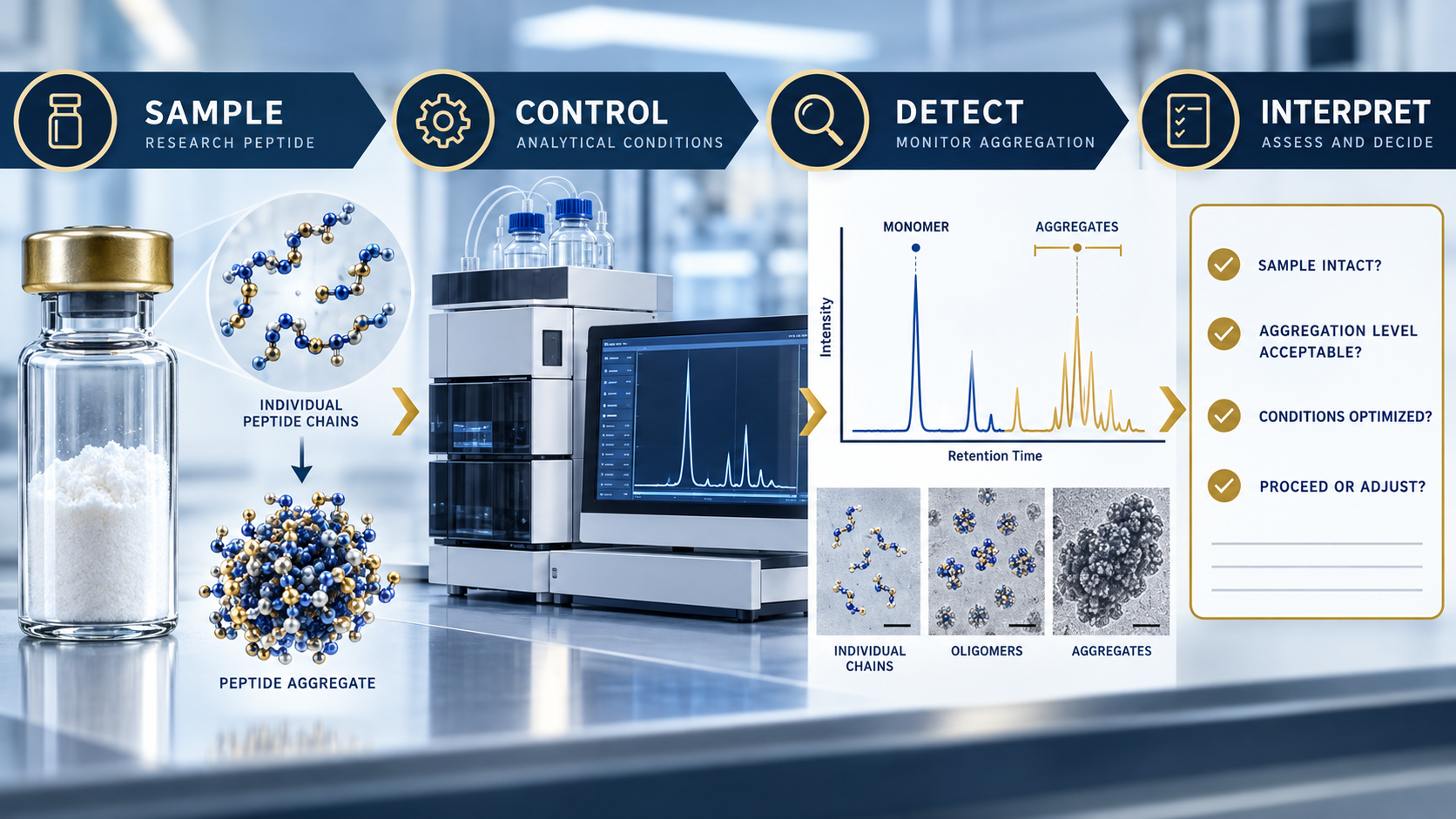
Aggregation describes a change in association state, from individual peptide molecules to dimers, oligomers, or larger assemblies. The term is broad: the observed material may be reversible or persistent, soluble or particulate, and driven by different physical or chemical factors. A label such as “aggregate” should therefore be tied to a defined method and observation.
Sequence, hydrophobicity, charge, concentration, buffer, pH, ionic strength, temperature, container surface, agitation, freeze–thaw history, and time can all influence the result. These variables are experimental context, not universal rules for every peptide.
Why aggregation is an analytical and quality question
Aggregation can change how a sample behaves in chromatography, filtration, spectroscopy, particle-size analysis, or sample recovery. It may also cause an apparent loss from the expected main peak because material is retained, precipitated, or excluded from the measurement. A lower reported peak area does not by itself identify the cause.
For this reason, a laboratory should document the material state and method conditions before interpreting a difference. The same sample may produce different signals when the container, preparation time, filter, injection path, or detection principle changes.
Control the sample before measuring it
Record identity and preparation
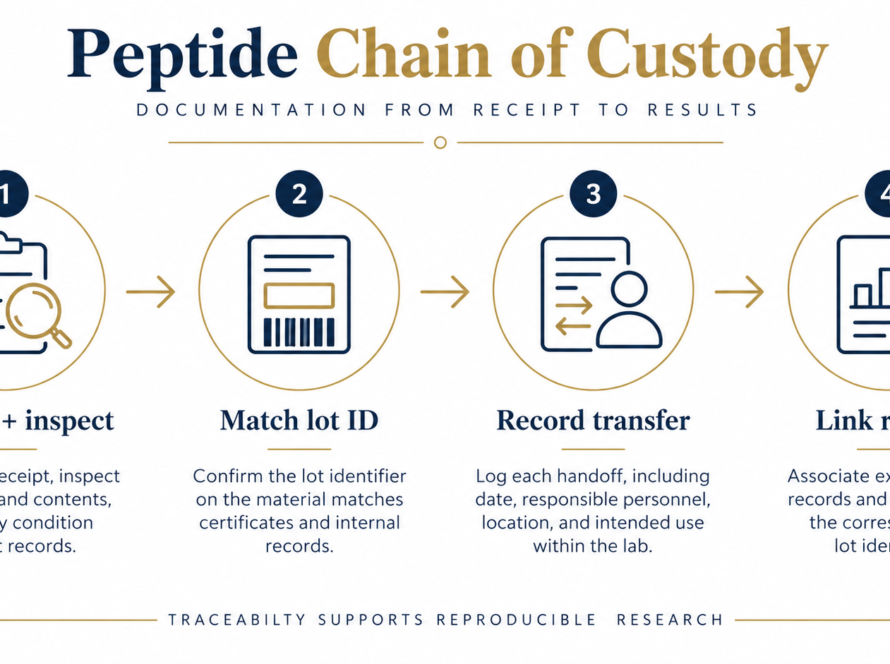
Capture the research reference, lot or batch, physical form, concentration or nominal amount used for the experiment, buffer or solvent context, container, preparation time, and handling history. The goal is traceability, not a personal-use protocol.
Control container, pH, and handling variables
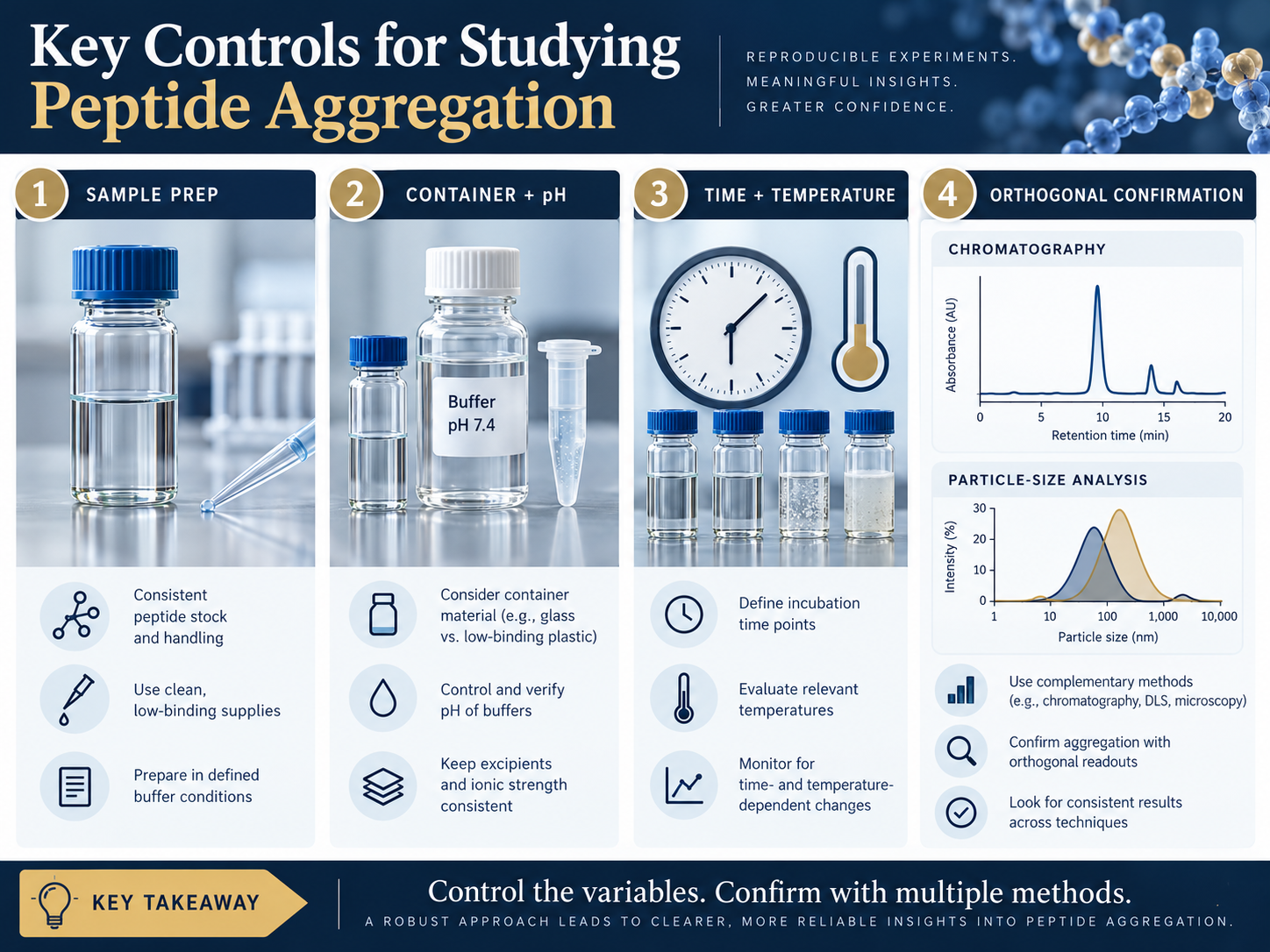
Use a defined container and documented buffer conditions. Where relevant, compare low-binding and standard materials as an explicit study variable rather than assuming the difference is negligible. Record mixing, hold time, temperature, and any filtration or centrifugation that could remove or redistribute material.
How laboratories detect aggregation
Chromatographic signals
Size-exclusion or other chromatographic approaches may reveal earlier-eluting species, broadened peaks, recovery changes, or a shift in the main profile. Interpretation depends on column chemistry, mobile phase, injection conditions, and system suitability. A new peak is an observation that needs confirmation, not automatic proof of a specific structure.
Particle and size-based methods
Dynamic light scattering, microscopy, or related particle measurements can add information about size distributions. These methods are sensitive to concentration, dust, bubbles, viscosity, and sample preparation. A size signal should be interpreted with controls and repeat measurements.
Orthogonal confirmation
Complementary methods can test whether signals from one method are consistent with another. Mass-based evidence, chromatography under a different separation principle, spectroscopy, or microscopy may be appropriate depending on the material. The chosen method should answer a defined question and include its limitations.
Design controls that make an aggregation result interpretable
- Run a baseline sample before the planned hold or stress condition.
- Keep a control with the same container, buffer, and handling but without the variable being tested.
- Use replicate preparations when the method or sample is sensitive to handling.
- Record timepoints and temperature history, not only the final result.
- Include system suitability and reference checks appropriate to the analytical method.
- Document unexpected particles, bubbles, filter use, or instrument events.
How to distinguish aggregation from other causes
A cloudy appearance, visible particle, or lower chromatographic recovery can have multiple explanations. Precipitation, adsorption to a container or filter, degradation, incomplete dissolution, air bubbles, carryover, and instrument variability may produce overlapping observations. Use controls and orthogonal evidence before assigning a mechanism.
Established finding: a defined method detected a changed signal under the tested conditions. Proposed mechanism: the change may involve oligomerization or another association state. Inference: the result could matter under a different formulation or workflow. These statements should not be written as if they carry the same level of certainty.
Study limitations and evidence boundaries
A laboratory aggregation experiment is specific to its material, container, method, and time window. It does not establish a universal storage condition, a shelf life, a release decision, sterility, biological activity, or suitability for human or veterinary use. The EMA synthetic-peptide guideline highlights the need to consider high-molecular-weight impurities and to use suitable analytical procedures; that guidance still requires product- and study-specific evidence.
Common interpretation errors
- Calling every visible particle an aggregate without a defined analytical basis.
- Assuming one peptide’s behavior predicts another sequence or formulation.
- Comparing results made with different containers, buffers, or methods as if they were identical.
- Treating a single chromatogram as complete identity or structural proof.
- Reporting a size distribution without controls for concentration, dust, bubbles, and viscosity.
- Turning an analytical observation into a treatment, dosing, or personal-use claim.
Related Peptides Skin research resources
- Peptide Stability Testing: Forced Degradation and Evidence Interpretation
- HPLC vs LC-MS for Peptide Analysis
- How to Read a Peptide COA
- Research Resources, COA Guides, and Laboratory Methods
Frequently asked questions
Does a cloudy sample prove peptide aggregation?
No. Cloudiness can reflect particles, precipitation, bubbles, incomplete preparation, or other causes. A defined method and suitable controls are needed.
Can HPLC alone identify an aggregate?
Not always. HPLC can show a changed profile, but the identity and mechanism of that signal may require orthogonal evidence.
Why do container materials matter?
Surface interactions can affect recovery and apparent concentration. Container choice should be recorded and tested when it is relevant to the study question.
Is aggregation always irreversible?
No. Association states can differ in reversibility and persistence. The study should define the observation and avoid assuming reversibility without evidence.
Does an aggregation result apply to every lot?
No. It applies to the tested material and conditions. Lot-to-lot conclusions require their own traceable evidence.
What does this article not establish?
It does not establish a universal storage condition, shelf life, batch release, sterility, biological activity, dosing, treatment, diagnosis, or personal-use suitability.
Research-use-only boundary
For laboratory research and educational purposes only. Not for human or veterinary use. This article provides no dosing, administration, treatment, diagnosis, prevention, or personal-use instructions.
Sources
- EMA: Guideline on the Development and Manufacture of Synthetic Peptides
- ICH Quality Guidelines: stability and analytical quality framework
- FDA Pharmaceutical Quality Resources
- PMC: Regulatory Guidelines for the Analysis of Therapeutic Peptides and Proteins
Editorial evidence and source review
How this article was prepared: Peptides Skin Editorial reviewed the topic against the linked primary literature, standards, and official sources available on 26 October 2026. The article separates measured observations from proposed mechanisms and inference. Conclusions apply only to the material, model, method, and conditions described here.
Evidence boundary: A research result, certificate, analytical signal, or preclinical finding should not be generalized to a different batch, formulation, study population, or personal-use context. Readers should consult the original source for its full methods and limitations.
Primary and authoritative source pathways
- PubMed: peptide aggregation analytical methods
- FDA Pharmaceutical Quality Resources
- ICH Quality Guidelines
Editorial scope: this page is for laboratory research education and does not provide medical, dosing, administration, treatment, diagnosis, or personal-use instructions.