


Short answer: Peptide stability testing is a structured way to observe how a defined material changes under controlled conditions over time. A useful study separates baseline characterization, deliberate stress, scheduled sampling, stability-indicating analysis, and evidence-based interpretation. It does not create a universal shelf life or prove that one online batch represents another.

What peptide stability testing is designed to answer
A stability study asks how the identity, purity, physical state, and measurable attributes of a defined peptide change under specified conditions. The answer is always linked to the material tested, the container or formulation, the analytical method, and the study design. A general storage statement is not a substitute for this evidence.
For research laboratories, the most useful output is a traceable data package: sample identity, lot or batch, condition, timepoint, analytical result, observed change, and interpretation. The same discipline helps a team distinguish a real degradation signal from a method artifact or an untracked handling event.
Why forced degradation is used in peptide research
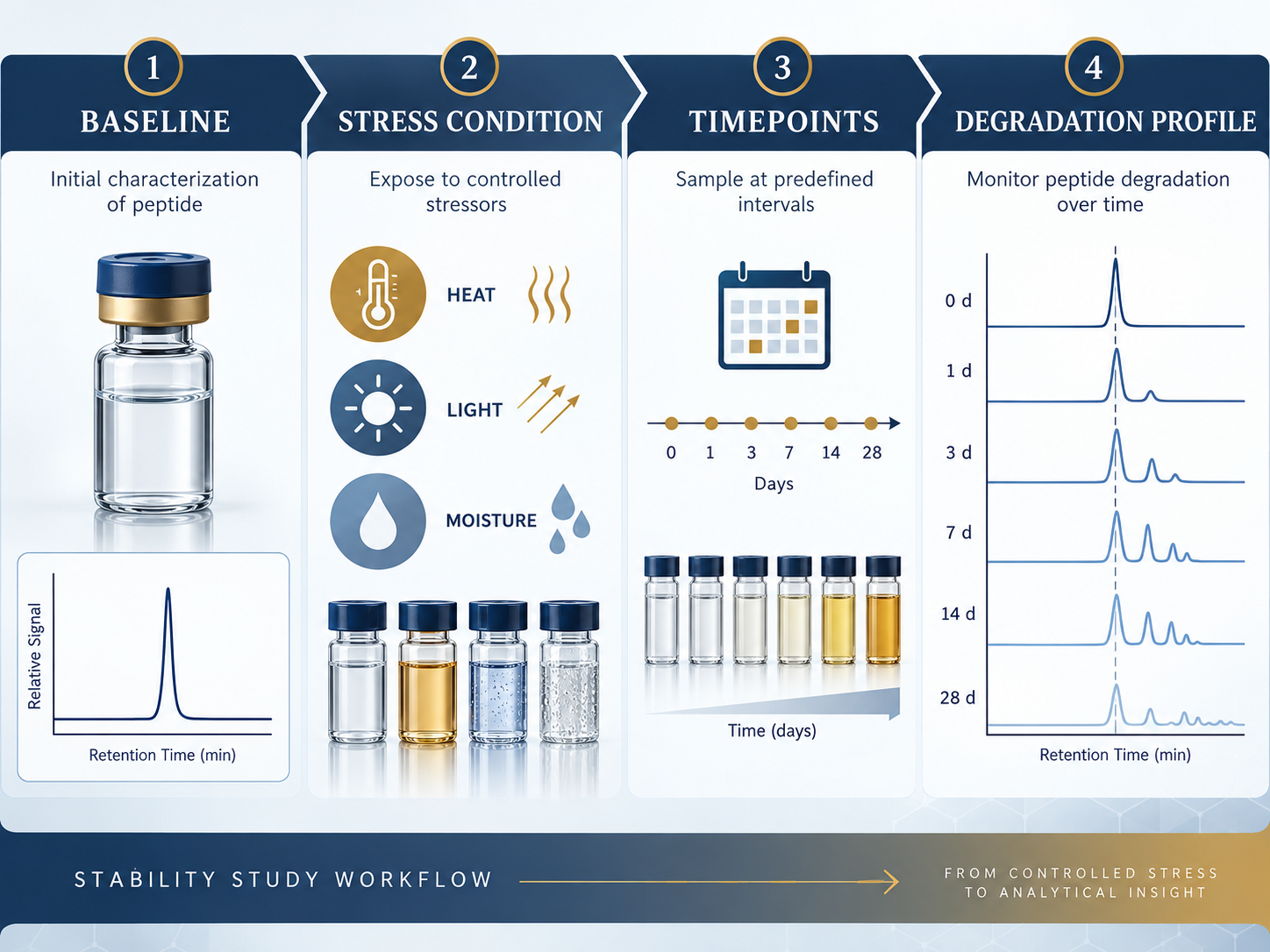
Forced degradation, also called stress testing, deliberately exposes a material to conditions that may accelerate change. The aim is not to simulate every shipping or storage event. It is to reveal plausible degradation pathways and to test whether the analytical method can separate the parent peptide from related species.
Stress conditions must be justified for the material and the question being studied. Heat, light, moisture, oxidation, pH, agitation, and freeze–thaw cycling may be relevant in different settings, but adding more stress does not automatically make a study better. Excessive stress can create products that are not representative of ordinary handling.
Build the baseline before applying stress
Confirm the material and physical state
Record the research reference, lot or batch identifier, vial or container, physical form, formulation or solvent context when relevant, and the sampling plan. Lyophilized material, solution, and frozen aliquots should not be treated as one interchangeable state.
Characterize the starting profile
Baseline testing should establish which attributes the method can observe before stress is applied. Depending on the study question, this may include chromatographic purity, identity confirmation, mass or molecular-weight evidence, appearance, moisture-related observations, or aggregation-related signals. The method and its limits should be documented rather than implied.
Choose stress conditions that answer a defined question
Temperature and time
Temperature stress can help reveal thermally accelerated change, but the chosen temperature and exposure period should be recorded with enough detail to make the experiment reproducible. A result at one temperature is not a direct prediction of every other condition.
Light, moisture, oxidation, and agitation
Light exposure, humidity, oxygen, repeated movement, and container opening can be relevant when they are connected to a plausible risk. The study should state the exposure, the control or comparator, and the reason the condition was selected.
Freeze–thaw and handling events
Repeated transitions between frozen and non-frozen states can be studied when they reflect a laboratory workflow. The number of cycles, dwell time, container, and sample recovery process should be recorded. A single visual inspection cannot establish molecular integrity.
Use stability-indicating analytical methods
An analytical method is stability-indicating when it can detect meaningful change and distinguish the parent material from relevant degradation products or related impurities. For peptides, chromatographic separation may need complementary identity or mass evidence because co-elution can hide change.
Chromatography and peak interpretation
Compare the starting chromatogram with later timepoints using the same documented method. Look for changes in the main peak, new or growing peaks, peak shape, retention behavior, and the balance of detected material. A single percentage value without method context is difficult to interpret.
Orthogonal evidence
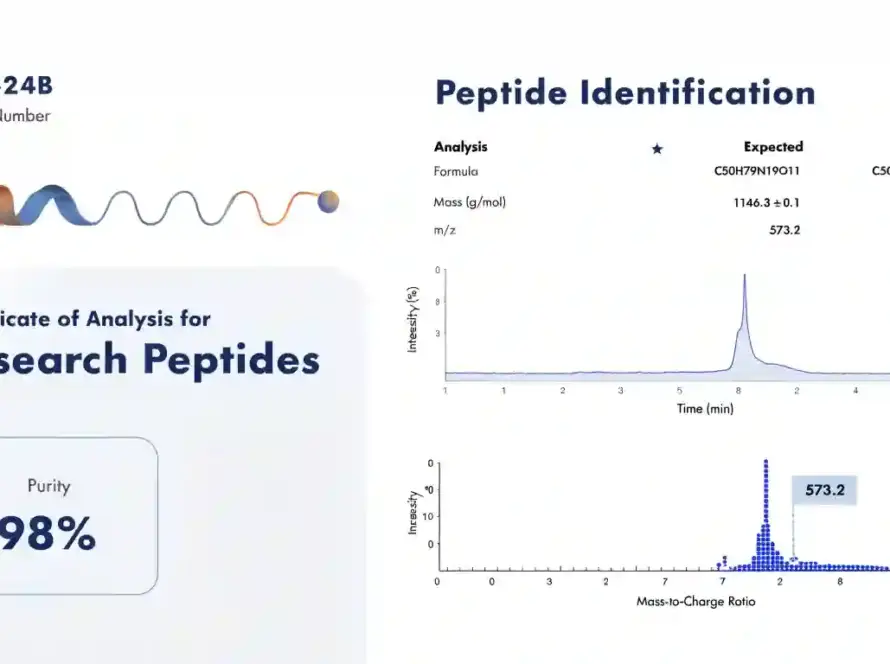
Orthogonal methods provide a different measurement principle. Mass spectrometry, complementary chromatographic modes, or other validated characterization tools may help investigate identity, truncations, oxidation, aggregation, or co-eluting species. The right combination depends on the peptide and the laboratory question.
Plan timepoints and controls
Timepoints should be selected before the study begins and should cover the baseline plus the expected progression of change. Include a defined control where possible, document sample handling, and preserve the chain of custody. A missing timepoint or unrecorded delay can weaken the conclusion even when the final chromatogram looks clear.
How to interpret a stability result without overclaiming
Interpret the observed result only within the tested material, condition, method, and time window. “No change detected” means that the method did not detect a defined change under the tested conditions; it does not prove zero molecular change. Conversely, a new peak is an observation that requires investigation, not automatic proof of a specific mechanism.
Separate established findings from hypotheses. The data may establish a change in a chromatographic profile, while the identity of that change may remain proposed until confirmed by an appropriate orthogonal method. A stability report should state those boundaries clearly.
Common study-design mistakes
- Using a universal temperature rule without documenting the material and physical state.
- Applying extreme stress without explaining what question it is intended to answer.
- Relying on appearance alone to establish identity, purity, sterility, or biological activity.
- Comparing results generated by different methods as if they were directly interchangeable.
- Reporting a percentage without the chromatogram, method conditions, lot, and timepoint.
- Turning a research observation into a guaranteed shelf life, release decision, or human-use claim.
Related Peptides Skin research resources
- How to Read a Peptide COA: Identity, Purity, and Lot Traceability
- How to Store Lyophilized Peptides: Stability, Light, and Moisture
- COA, HPLC, and Mass-Spectrometry Checklist
- Research Resources, COA Guides, and Laboratory Methods
Frequently asked questions
Does forced degradation predict the exact shelf life of a peptide?
No. It helps reveal pathways and test method capability. Shelf-life conclusions require product-specific studies, conditions, specifications, and justified interpretation.
Is a higher purity result proof that a sample is stable?
No. The result depends on the analytical method, reference standard, sample preparation, detected impurities, and timepoint. Purity should be interpreted with identity and method context.
Why test both lyophilized material and solution?
Physical state can change the stability context. A result for a dry vial should not automatically be transferred to a solution or frozen aliquot.
What does a stability-indicating method need to show?
It should be capable of detecting relevant change and separating the parent material from related degradation products or impurities under the study conditions.
Can one chromatogram prove peptide identity?
Not necessarily. Chromatography can show a profile, but identity confirmation may require an orthogonal method appropriate to the material and study question.
What does this article not establish?
It does not establish a universal storage condition, shelf life, batch release, sterility, biological activity, dosing, treatment, diagnosis, or personal-use suitability.
Research-use-only boundary
For laboratory research and educational purposes only. Not for human or veterinary use. This article provides no dosing, administration, treatment, diagnosis, prevention, or personal-use instructions.
Sources
- ICH Quality Guidelines: Q1A(R2), Q1B, Q1D, and Q1E stability guidance
- EMA: ICH Q1A(R2) Stability Testing of New Drug Substances and Products
- EMA: Guideline on the Development and Manufacture of Synthetic Peptides
- FDA Pharmaceutical Quality Resources: stability and analytical procedure guidance
Editorial evidence and source review
How this article was prepared: Peptides Skin Editorial reviewed the topic against the linked primary literature, standards, and official sources available on 26 October 2026. The article separates measured observations from proposed mechanisms and inference. Conclusions apply only to the material, model, method, and conditions described here.
Evidence boundary: A research result, certificate, analytical signal, or preclinical finding should not be generalized to a different batch, formulation, study population, or personal-use context. Readers should consult the original source for its full methods and limitations.
Primary and authoritative source pathways
Editorial scope: this page is for laboratory research education and does not provide medical, dosing, administration, treatment, diagnosis, or personal-use instructions.


1 Comment