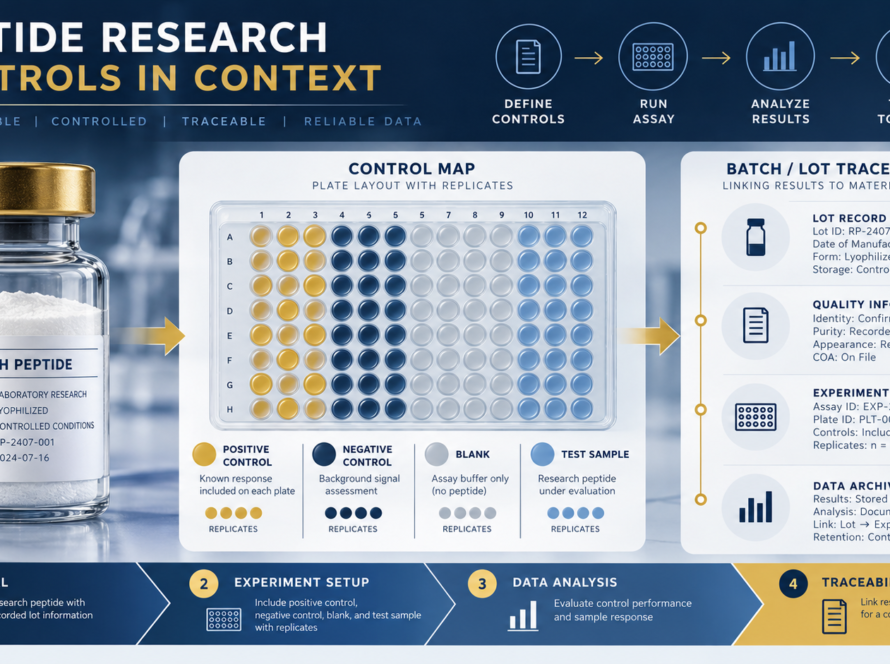


Short answer: Peptide method validation asks whether an analytical procedure is suitable for its stated purpose. Selectivity, precision, accuracy, range, and robustness should be evaluated against a defined claim, reference material, and written protocol. Validation supports confidence in a method; it does not turn a limited method into proof of every property of a research material.

What peptide method validation means
Validation is documented evidence that a procedure performs as expected for a particular matrix, range, instrument configuration, and intended use. A laboratory should write the question before selecting experiments: identity comparison, related-substance monitoring, assay measurement, or stability-indicating work require different evidence. A procedure validated for one purpose should not be silently extended to another.
Define the intended claim first
Start with a concise method statement. Identify the analyte, matrix, expected concentration range, instrument, sample preparation, reference material, and decision rule. State what the method will and will not conclude. This prevents a common error in peptide work: using a purity-oriented chromatogram as if it were a complete identity or sequence confirmation.
Core performance characteristics
Selectivity and specificity
Selectivity describes whether the method can distinguish the target signal from impurities, degradants, excipients, solvent effects, or matrix components. Review representative blanks, reference material, stressed or challenged samples where appropriate, and known potential interferents. Document chromatographic resolution, spectral evidence, or other criteria that support separation.
Precision
Precision describes agreement among repeated measurements. Repeatability uses the same conditions over a short interval; intermediate precision can include different days, analysts, instruments, or columns. Report the design and summary statistics that match the decision being made. Precision without selectivity can produce consistently wrong answers.
Accuracy or trueness
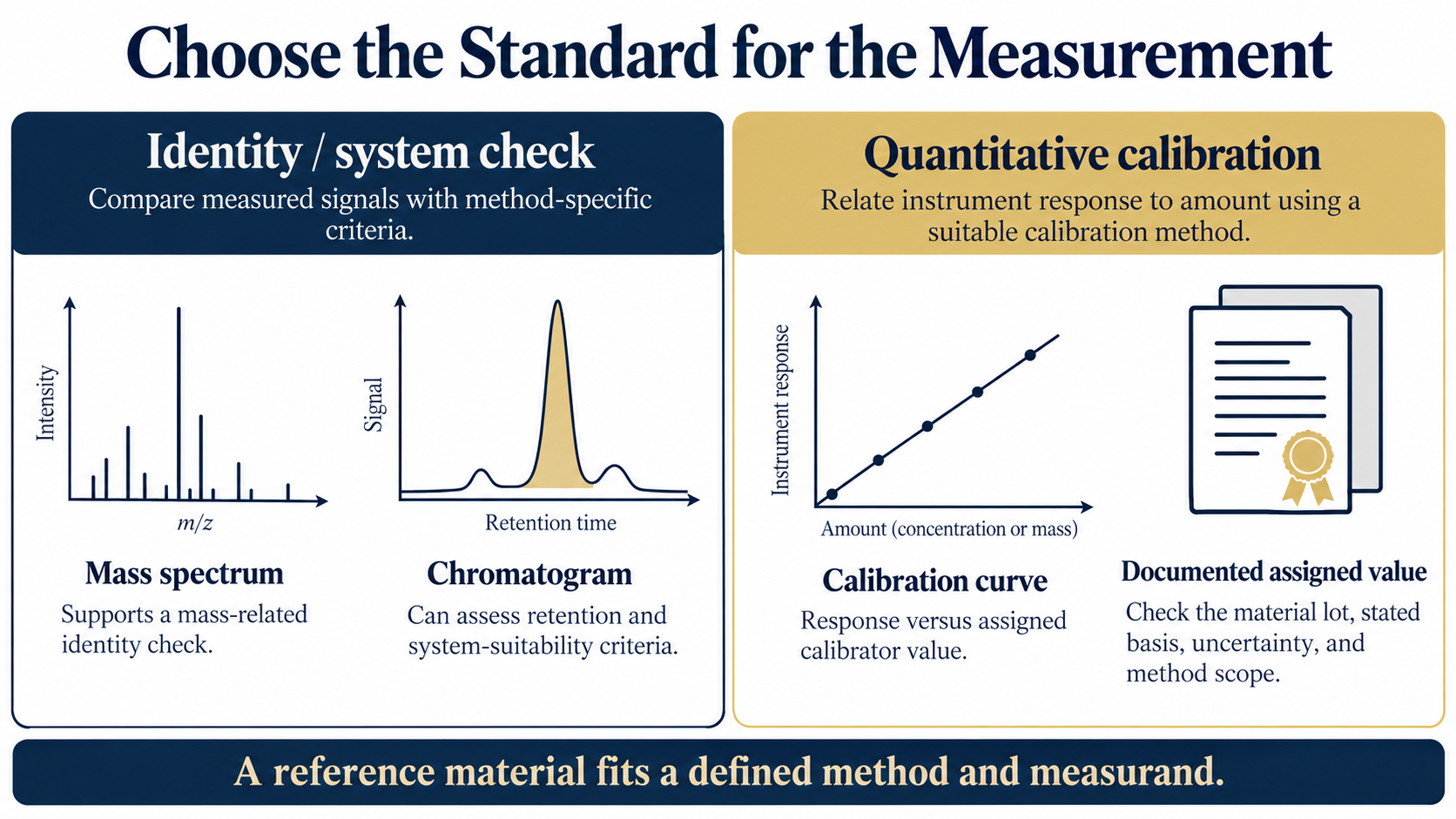
Accuracy evidence should be tied to a reference value, recovery design, or an orthogonal comparison that is appropriate for the method. Explain how the reference was assigned, what uncertainty accompanies it, and which sources of bias were considered. Avoid presenting recovery in one matrix as universal evidence for every peptide or method.
Range and response
The working range should cover the concentrations or signal levels relevant to the intended use. Evaluate response behavior and define how measurements are interpreted within that range. Extrapolating outside the studied range weakens the claim and should be labeled as such.
Robustness
Robustness examines the effect of deliberate, reasonable variations such as small changes in temperature, flow, composition, column lot, or sample age. The goal is to identify sensitive parameters and controls, not to make a method insensitive to all change. Record the tested ranges and the decision rule used to judge impact.
Reference materials and experimental design
A reference standard should have a documented source, lot identifier, assigned value or characterization basis, storage history, and expiry or review status. Replicates should be planned before testing, with blanks, controls, and system suitability checks where applicable. Randomization or run-order controls may help distinguish instrument drift from sample effects.
Interpreting failures and deviations
A failed criterion is information, not a reason to alter the protocol after seeing the results. Investigate instrument status, preparation records, analyst notes, system suitability, calculations, and sample history. If the method is revised, preserve the previous version and explain what changed. A transparent report separates observed data, interpretation, and inference.
Related Peptides Skin resources
See the controls and batch traceability guide, COA review guide, and orthogonal identity confirmation article for related documentation practices.
Frequently asked questions
Does validation prove a peptide is pure?
No. It documents performance for a defined method and claim. Purity, identity, and stability require appropriately selected evidence.
Is precision the same as accuracy?
No. Precision concerns agreement among repeated measurements; accuracy or trueness concerns closeness to an accepted reference value or comparator.
How many validation experiments are required?
There is no universal count. The design should be justified by the claim, risk, matrix, method complexity, and applicable quality guidance.
Can a supplier COA replace validation?
No. A COA may provide contextual documentation, but it does not validate a laboratory’s own procedure.
What should be done when robustness is weak?
Identify the sensitive parameter, add controls or narrower operating limits, and document whether the method remains fit for its intended use.
What does this article exclude?
It excludes dosing, administration, treatment, diagnosis, and personal-use instructions.
Research-use-only boundary
For laboratory research and educational purposes only. Not for human or veterinary use.
Sources
- ICH quality guidelines.
- FDA pharmaceutical quality resources.
- EMA synthetic peptide guideline.
- NIH/NLM PubMed Central.
Editorial evidence and source review
How this article was prepared: Peptides Skin Editorial reviewed the topic against the linked primary literature, standards, and official sources available on 26 October 2026. The article separates measured observations from proposed mechanisms and inference. Conclusions apply only to the material, model, method, and conditions described here.
Evidence boundary: A research result, certificate, analytical signal, or preclinical finding should not be generalized to a different batch, formulation, study population, or personal-use context. Readers should consult the original source for its full methods and limitations.
Primary and authoritative source pathways
- FDA analytical procedures and method validation guidance
- ICH Q2(R2) validation guidance
- PubMed: peptide analytical method validation
Editorial scope: this page is for laboratory research education and does not provide medical, dosing, administration, treatment, diagnosis, or personal-use instructions.