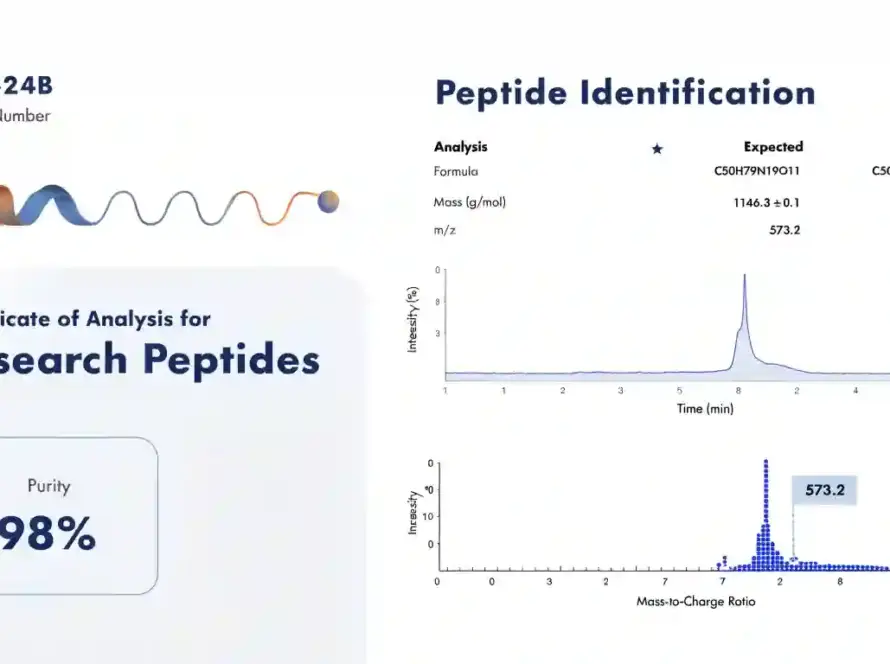


Short answer: A defensible peptide experiment links every reported result to a planned control set, justified replicates, and a traceable sample and lot record. Controls do not make a weak assay valid by themselves; they help researchers detect background, drift, contamination, plate effects, and batch-related differences before interpreting a signal.
Why controls matter in peptide research
Peptide assays can be sensitive to matrix composition, adsorption, preparation history, instrument drift, and analyst handling. A control plan makes those sources visible. It also creates a transparent basis for deciding whether a result is analytically interpretable, inconclusive, or suitable for follow-up.
The purpose is not to manufacture certainty. It is to separate an observed signal from the background and process variation that could produce a similar signal.
Define the research question before selecting controls
Start by stating what the experiment is intended to measure: identity, relative signal, apparent stability, binding response, or another defined analytical endpoint. The control set should match that question and the measurement platform. A control that is useful for a chromatographic system may not answer a cell-free binding question, and neither automatically establishes biological activity.
Positive controls
A positive control is a material or condition expected to produce a defined response in the chosen method. It confirms that the assay and detection system can respond under the run conditions. The expected response should be documented before the run, including any acceptance range used by the laboratory.
Negative controls and blanks
A negative control is expected not to produce the target response. A blank contains the relevant matrix or solvent without the target analyte. These controls help distinguish analyte-associated signal from background, carryover, reagent response, or instrument noise. They are related but not interchangeable; the correct choice depends on the question and the sample preparation path.
Test samples and reference material
Test samples should be identified independently from the expected outcome. When a reference material is used, record its source, assigned value or characterization basis, storage history, and relationship to the method. Avoid treating a catalog description or a single certificate field as proof that an experimental result is valid.
Replicates and variability
Replicates provide information about variation under the conditions actually used. They do not convert a biased design into an unbiased one, and they should not be added only after an unexpected result appears.
Technical versus independent replicates
Technical replicates repeat measurement from the same prepared sample or run context. Independent replicates repeat a preparation, run, or experiment in a way that samples a broader source of variation. Reports should name which type was used instead of using the single word “replicate” without context.
Why replicate number needs justification
Replicate counts should reflect the assay’s expected variability, the precision needed for the research question, and practical limits of the platform. Document exclusions, failed wells, reinjections, and any rule applied before looking at the final comparison. This supports a reproducible interpretation without implying clinical significance.
Link each result to the batch and lot
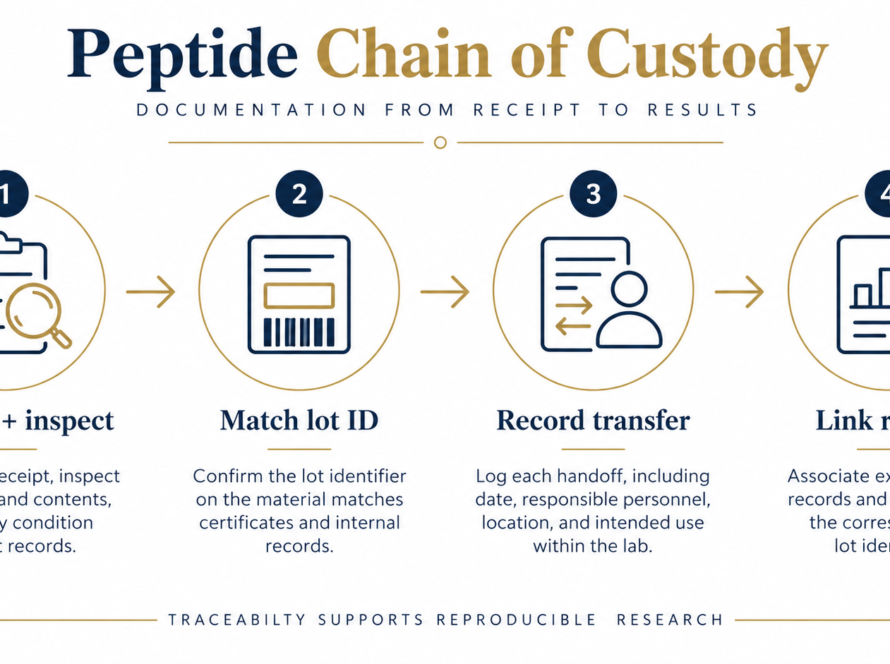
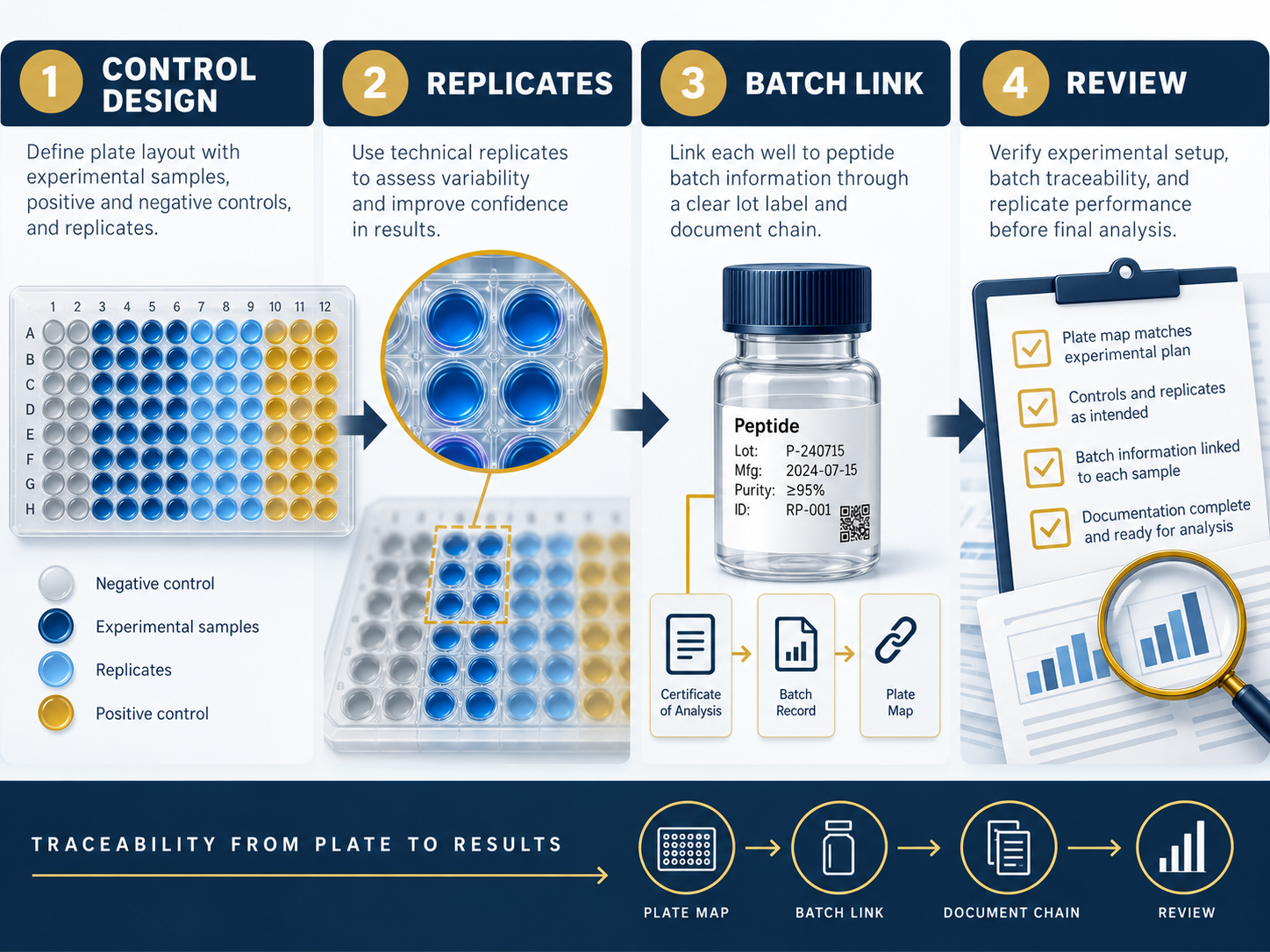
Traceability is the bridge between a result and the material that produced it. Use a stable sample identifier and preserve the connection to the product name, lot or batch identifier, received condition, preparation record, and instrument run.
Minimum lot-linked record
- Material name and internal sample ID
- Supplier or source, lot or batch number, and date received
- Storage condition and any documented excursion
- Preparation details needed to reproduce the analytical sample
- Run date, instrument or method version, analyst, and file location
- Linked COA, HPLC or LC-MS record, and deviation notes where applicable
Plate maps and sample identifiers
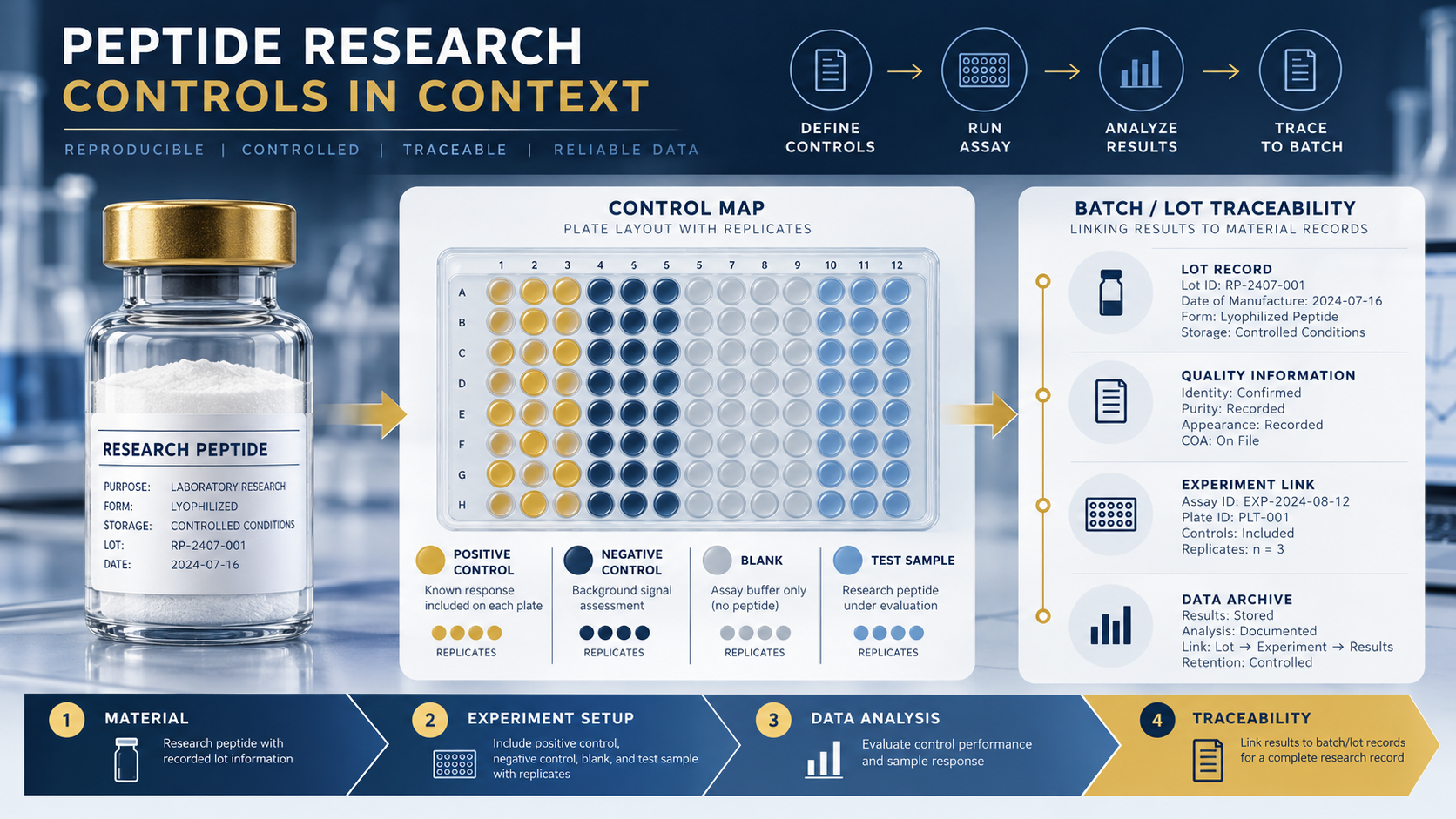
A plate map or injection sequence should show where blanks, controls, reference material, and test samples were placed. Use identifiers that remain readable after files are exported or reviewed outside the original software. This reduces transcription errors and makes later comparisons more defensible.
Review control performance before interpreting samples
Review the controls first. Ask whether the positive control responded as expected, whether the negative control and blank remained within the predefined background range, and whether replicate spread is plausible for the method. If a control fails, record the failure and decide whether the run is invalid, qualified, or suitable only for exploratory follow-up. Do not silently remove inconvenient observations.
Common control-design mistakes
- Using a blank where a matrix-matched negative control is needed.
- Calling repeated wells independent experiments when they share one preparation.
- Changing control criteria after seeing the sample results.
- Reporting a lot number without linking it to the actual prepared sample.
- Assuming a control proves peptide identity, purity, potency, or biological activity beyond what the method measures.
Related Peptides Skin research resources
For documentation context, see how to read a peptide COA, HPLC versus LC-MS peptide analysis, peptide stability testing and forced degradation, and the Peptides Skin research resources library.
FAQs
What is a positive control in peptide research?
It is a material or condition expected to produce a defined response in the selected method. It checks that the assay and detection system are functioning under the documented run conditions.
What is the difference between a negative control and a blank?
A negative control is expected not to produce the target response, while a blank omits the target analyte and is used to estimate background from the matrix, solvent, reagents, or instrument.
Are technical replicates the same as independent experiments?
No. Technical replicates repeat measurement within the same preparation or run context. Independent replicates repeat a preparation or experiment to sample additional sources of variation.
Why should results be linked to a peptide lot?
Lot linkage preserves the chain from received material to prepared sample and instrument result. It supports review of batch differences, documentation, and reproducibility.
Can controls prove peptide identity or purity?
No. Controls test defined aspects of an analytical workflow. Identity and purity require methods and evidence appropriate to those questions, such as validated chromatographic or mass-spectrometric characterization.
What does this article not establish?
It does not establish clinical efficacy, safety, dosing, administration, diagnosis, treatment, or suitability for human or veterinary use.
Research-use-only boundary
For laboratory research and educational purposes only. Not for human or veterinary use.
Sources and documentation
- U.S. FDA Pharmaceutical Quality Resources
- ICH Quality Guidelines
- European Medicines Agency guideline on development and manufacture of synthetic peptides
- PubMed Central research archive
Editorial evidence and source review
How this article was prepared: Peptides Skin Editorial reviewed the topic against the linked primary literature, standards, and official sources available on 26 October 2026. The article separates measured observations from proposed mechanisms and inference. Conclusions apply only to the material, model, method, and conditions described here.
Evidence boundary: A research result, certificate, analytical signal, or preclinical finding should not be generalized to a different batch, formulation, study population, or personal-use context. Readers should consult the original source for its full methods and limitations.
Primary and authoritative source pathways
- FDA bioanalytical method validation guidance
- ICH Q2(R2) validation guidance
- PubMed: peptide assay controls and replicates
Editorial scope: this page is for laboratory research education and does not provide medical, dosing, administration, treatment, diagnosis, or personal-use instructions.