


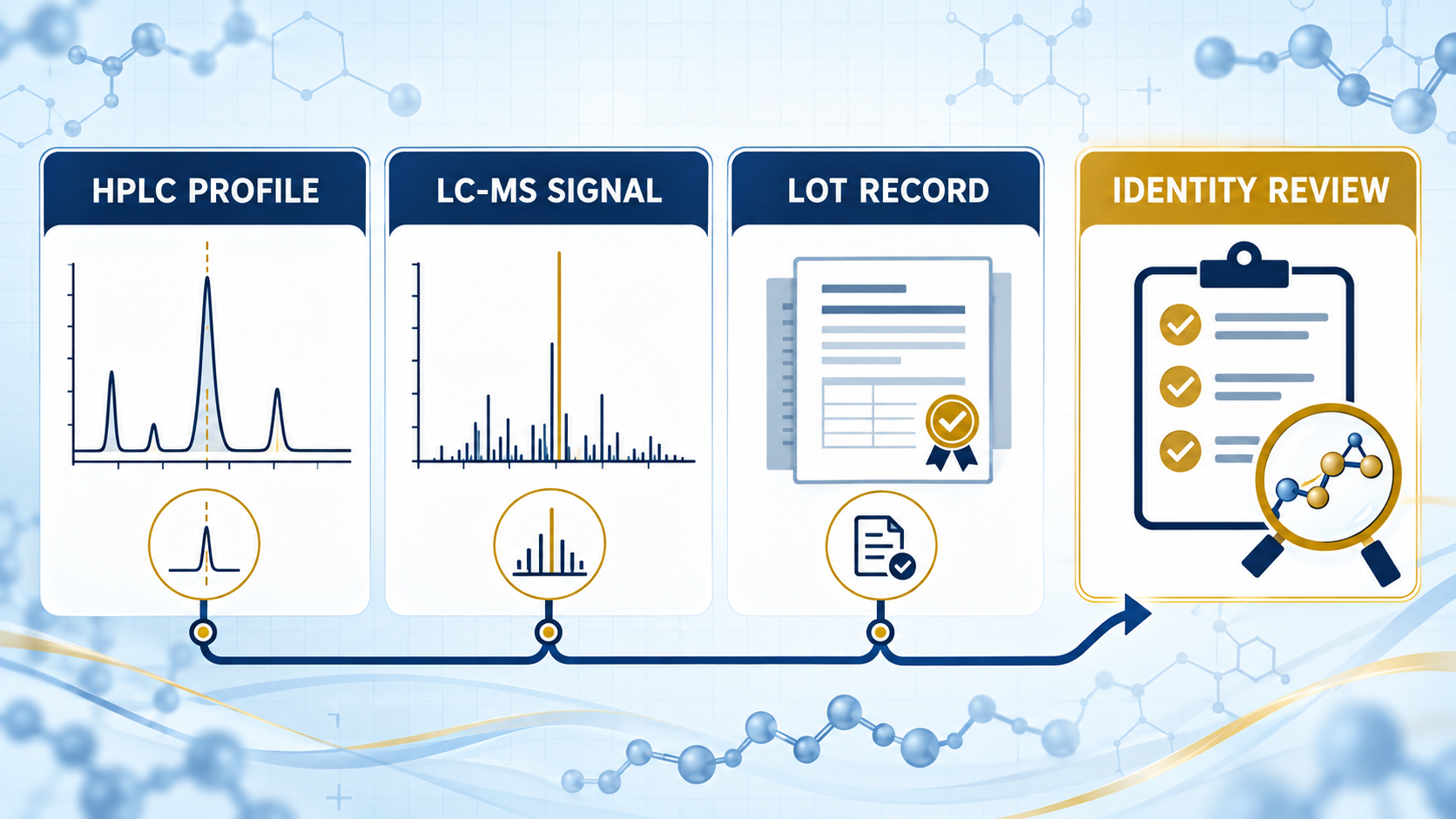
Short answer: Peptide identity confirmation is strongest when laboratories evaluate more than one independent signal. HPLC can show a chromatographic profile, LC-MS can provide mass-related evidence, and lot documentation can connect the tested material to its recorded batch. Agreement improves confidence, but it does not eliminate method limits or prove every structural attribute.
Why peptide identity is an analytical question
Identity is not the same as purity, potency, or suitability for a particular experiment. A laboratory should define the claim first: a catalog identity check, a comparison with a reference material, or a broader characterization exercise. The evidence required depends on that claim, the method’s selectivity, and the quality of the reference standard.
Fit the method to the claim
Analytical methods answer different questions. A reversed-phase HPLC method separates components under defined conditions and records retention behavior. An LC-MS measurement can provide a mass-to-charge signal consistent with an expected molecular mass. Batch records and a certificate of analysis help establish traceability, but they are documents—not substitutes for understanding the analytical method.
What an HPLC profile can show
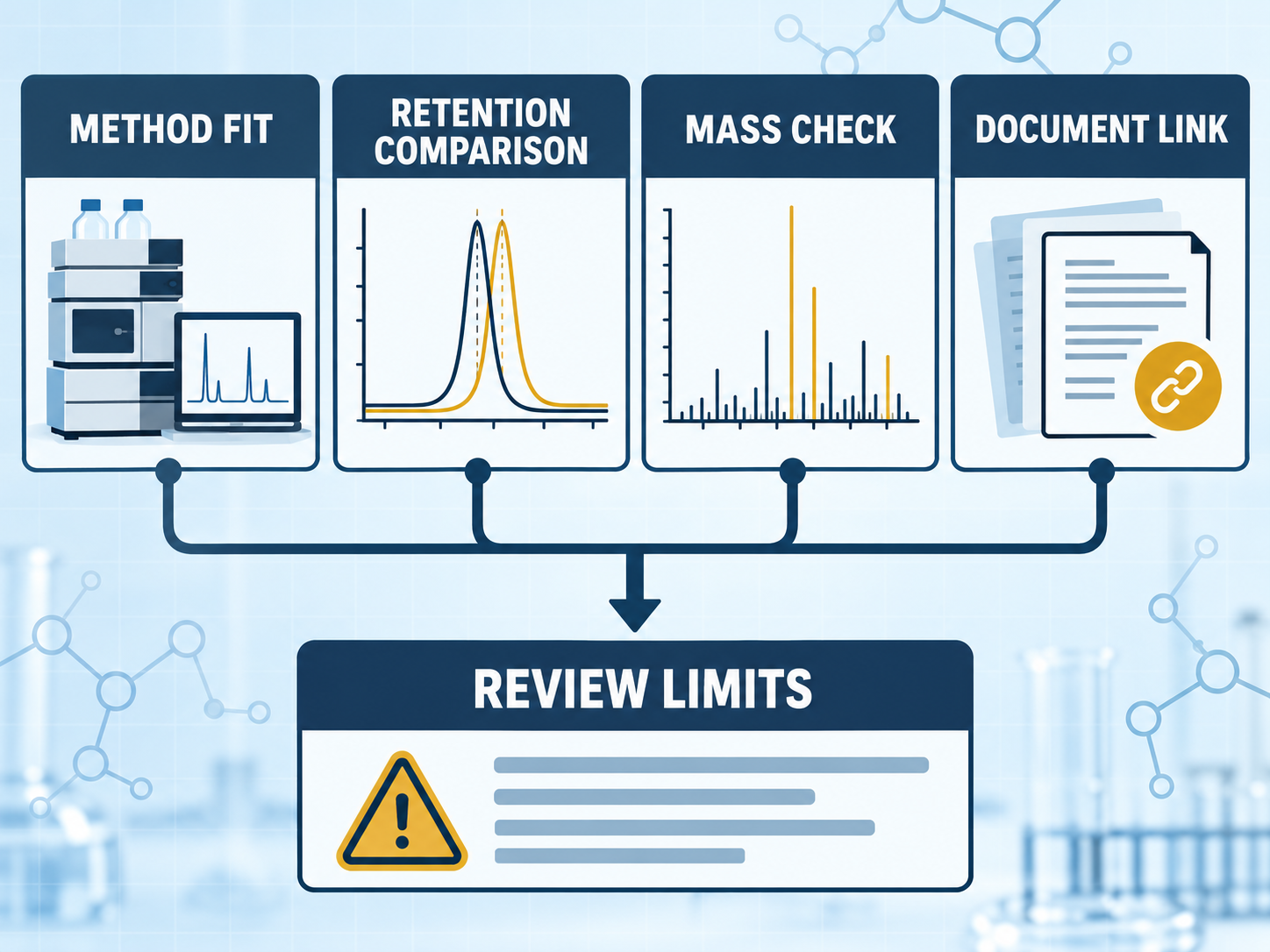
HPLC retention time and peak pattern can support comparison when the column, mobile phase, gradient, detector, flow rate, temperature, and reference material are documented. Retention agreement is conditional: a similar peak position under one method does not establish identity across all possible methods, and a reported area percentage should not be treated as a complete structural characterization.
What LC-MS adds
LC-MS can add mass-related evidence by linking chromatographic separation with an observed ion signal. Interpretation should account for charge states, adducts, isotopic patterns, instrument calibration, and the expected molecular form. A matching nominal mass alone is not unique proof because unrelated species can share or approximate a mass-to-charge value.
What lot documentation adds
Lot numbers, test dates, method references, storage notes, and supplier documentation connect an analytical result to a defined material history. Documentation is most useful when the identifiers on the vial, chromatogram, report, and COA agree and when revisions are controlled.
Why orthogonal evidence is stronger than one signal
HPLC retention behavior and LC-MS mass evidence measure different properties. When both are generated with fit-for-purpose methods and linked to the same lot, they provide complementary support. The conclusion should still be written at the level justified by the data: “consistent with the expected identity under the stated methods,” rather than an unlimited claim of purity, sequence, conformation, or biological activity.
What discordant results can mean
A retention-time match with a weak or unexpected mass signal may indicate an interfering peak, an incorrect reference, an adduct or charge-state issue, calibration drift, sample carryover, degradation, or a documentation mismatch. Conversely, a plausible mass with a different chromatographic pattern can reflect a co-eluting species, an isomeric or modified form, or inadequate chromatographic selectivity. Discordance should trigger a documented investigation—not a forced conclusion.
Reporting limits and uncertainty
Reports should state the sample and lot identifier, method version, instrument or system identifier, reference material, relevant acceptance criteria, observed results, deviations, and reviewer. Include uncertainty or qualification language where appropriate. If the method was not validated for the intended matrix or claim, say so explicitly.
Common interpretation errors
- Calling a single HPLC peak proof of identity without a reference or method context.
- Using a nominal LC-MS mass without considering charge state, adducts, or calibration.
- Treating a supplier COA as independent confirmation of every attribute.
- Combining data from different lots without preserving traceability.
- Reporting “confirmed” when the data only support “consistent with.”
Related Peptides Skin research resources
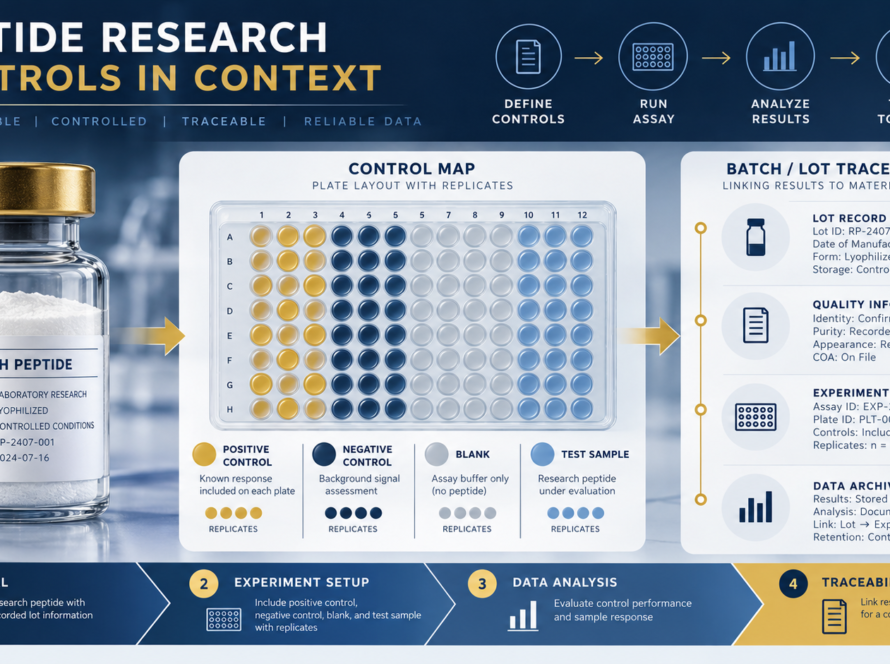
For method comparisons, see HPLC vs. LC-MS peptide analysis and how to read a peptide COA. For controlled study records, review research controls, replicates, and traceability. The research resources library provides additional quality and documentation guides.
Frequently asked questions
What does HPLC show for a research peptide?
It shows separation behavior and a chromatographic profile under stated conditions. It can support comparison, but retention time is method-dependent and does not alone prove full molecular identity.
What does LC-MS add?
LC-MS adds mass-to-charge evidence that can be compared with an expected molecular form. Charge states, adducts, calibration, and sample context must be considered.
Do matching HPLC and LC-MS results prove identity?
They can provide stronger orthogonal support when methods are fit for purpose and the same lot is traceable. The conclusion should remain limited to what the documented methods establish.
What if the chromatogram and mass result disagree?
Pause the conclusion and investigate method fit, reference material, instrument performance, sample condition, possible interference, and lot documentation.
Can a COA replace in-house testing?
A COA documents reported testing and specifications, but whether it is sufficient depends on the laboratory’s quality system, intended claim, and applicable requirements. It should not be presented as universal proof.
What does this article not establish?
It does not provide dosing, administration, treatment, diagnostic, or personal-use guidance, and it does not certify any individual lot.
Research-use-only boundary
For laboratory research and educational purposes only. Not for human or veterinary use.
Sources and documentation
- FDA pharmaceutical quality resources.
- ICH quality guidelines.
- EMA guideline on development and manufacture of synthetic peptides.
- NIH/NLM PubMed Central for primary literature searches.
Editorial evidence and source review
How this article was prepared: Peptides Skin Editorial reviewed the topic against the linked primary literature, standards, and official sources available on 26 October 2026. The article separates measured observations from proposed mechanisms and inference. Conclusions apply only to the material, model, method, and conditions described here.
Evidence boundary: A research result, certificate, analytical signal, or preclinical finding should not be generalized to a different batch, formulation, study population, or personal-use context. Readers should consult the original source for its full methods and limitations.
Primary and authoritative source pathways
- PubMed: peptide identity and LC-MS/HPLC methods
- FDA Pharmaceutical Quality Resources
- EMA synthetic peptide guideline
Editorial scope: this page is for laboratory research education and does not provide medical, dosing, administration, treatment, diagnosis, or personal-use instructions.


2 Comments